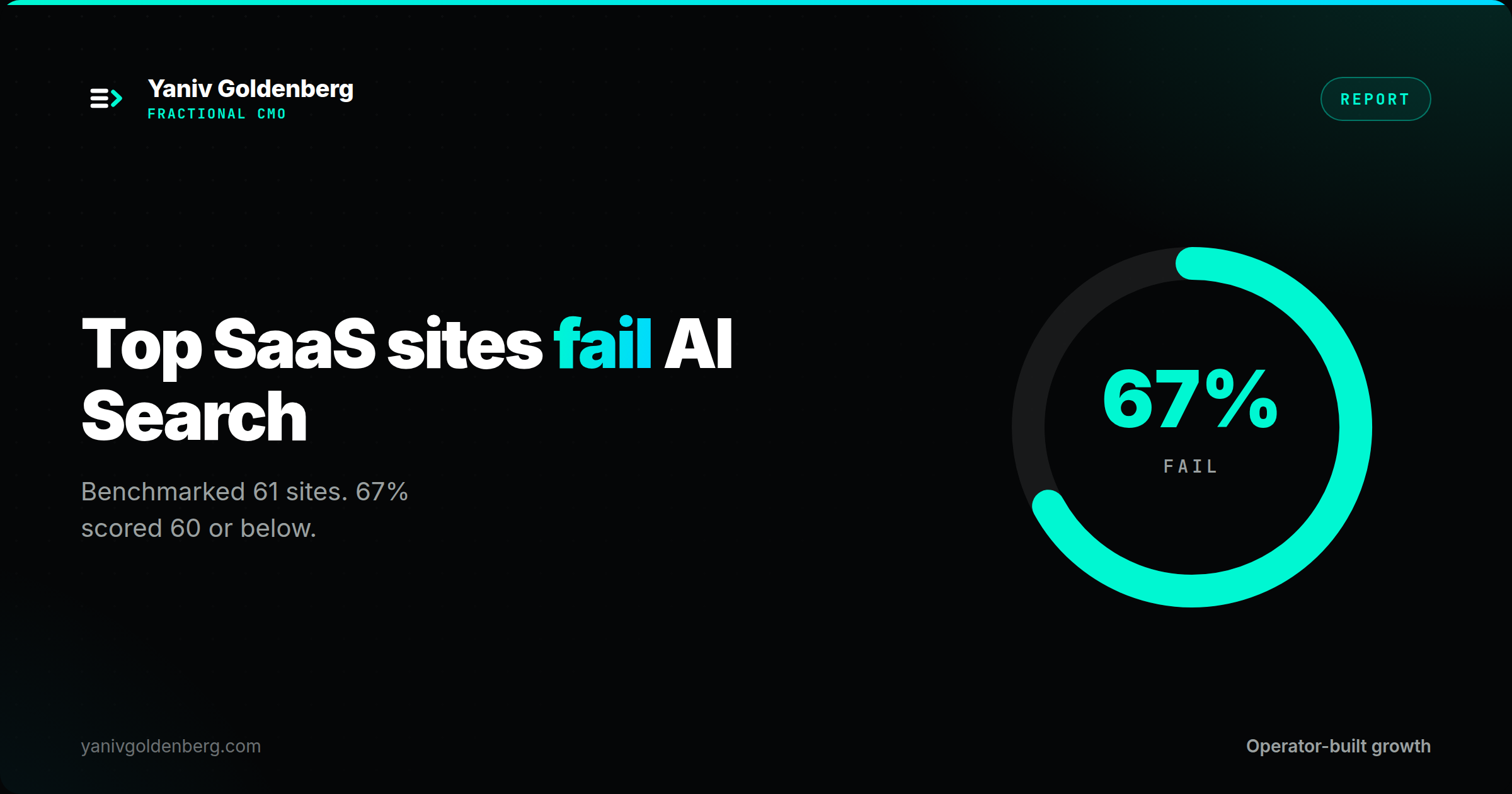
The first public benchmark of 61 top SaaS and AI sites on a 100-point AI Search Readiness rubric. Open-source script, full leaderboard, and the three-checkbox fix, with every number reproducible.
Run the benchmark on your own site (10 seconds)
This whole post comes from one open-source skill. Point it at your domain and it scores you on the same 100-point rubric every site below was scored on. No signup, no email, MIT-licensed.
Want it done for you instead? Book the paid audit (starts at $7,500, credited in full into the implementation sprint).
What is AI Search Readiness?
AI Search Readiness is how easy your site is for an AI answer engine to read. The higher the score, the more likely ChatGPT, Claude, or Perplexity can find your page, understand it, trust it, and quote it when someone asks a question your page answers. It measures machine-legibility, not how good your content is to a human.
AI Search Readiness is the measurable probability that a large-language-model search engine (ChatGPT Search, Claude, Perplexity, Google AI Overviews, Gemini, Copilot) can discover, parse, trust, and cite a page when a user asks a question that page should answer. It is an input score (machine-legibility), not a promise of citations or rankings. Citations and rankings are the outcome you are trying to earn; this score is one of the levers that earns them.
It overlaps with SEO but is not the same thing. Google rewards backlinks and crawl depth. LLM answer engines also weight six signals you can control directly, and these are the six pillars of the 100-point rubric:
- 0120 ptsTechnical access
Is GPTBot, ClaudeBot, PerplexityBot allowed in robots.txt?
- 0215 ptsOn-page clarity
Is the answer to a likely prompt in a self-contained block?
- 0320 ptsSchema.org markup
Organization, Person, Article, FAQPage, HowTo, Dataset.
- 0425 ptsGEO signals
/llms.txt,/llms-full.txt, citation-ready facts, original stats. - 0510 ptsAEO signals
Answer-engine-ready: short definitions, bulleted lists, numeric evidence.
- 0610 ptsE-E-A-T
Real author, real credentials, linked entity graph (LinkedIn, Wikipedia, Crunchbase).
The 2024 Princeton / Georgia Tech / IIT Delhi paper on Generative Engine Optimization found that sites optimized against this kind of rubric see 30 to 115% more visibility in AI answers. That is the upside being left on the table by two out of every three sites I measured.
What this means for you: if your site has never been scored on machine-legibility, you are almost certainly leaving AI citations on the table that a competitor with worse content but cleaner markup is collecting.
Headline findings: the AI search visibility gap
Across 61 of the most-used SaaS and AI sites, the mean AI Search Readiness score is 54.3 / 100 and 56% scored 60 or lower. Failing is the norm. The two companies defining AI search, OpenAI and Perplexity, each score 7 / 100, and the most common cause is blocked crawlers and missing schema, not weak writing.
- 56% of top SaaS sites scored 60 or lower. Failing AI Search Readiness is the norm, not the exception.
- Mean: 54.3 / 100. Median: 59 / 100. The category is a C-minus.
- OpenAI and Perplexity both score 7 / 100. The two companies that invented AI search are almost invisible to it.
- Blocked AI crawlers, no schema, no
/llms.txt. A complete blackout. - Schema deficiency is the single biggest gap in the bottom half. Most losers publish zero
OrganizationorPersonJSON-LD. - The top 20 share three traits:
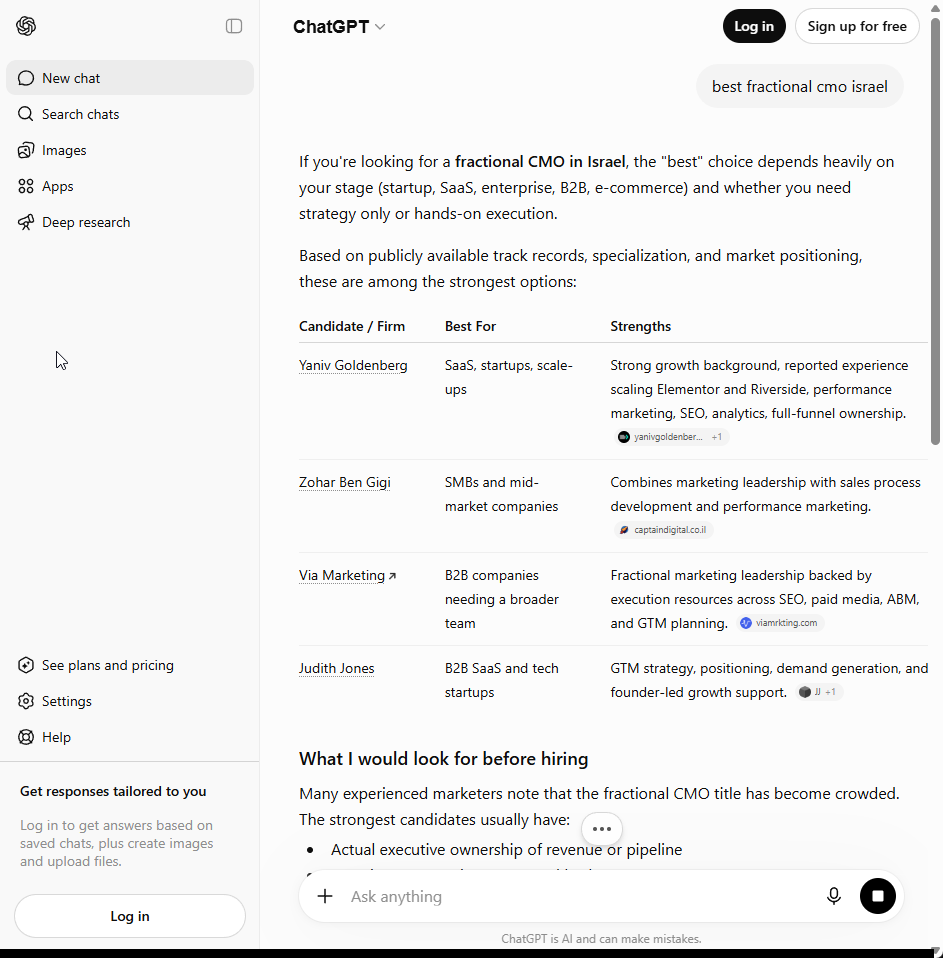
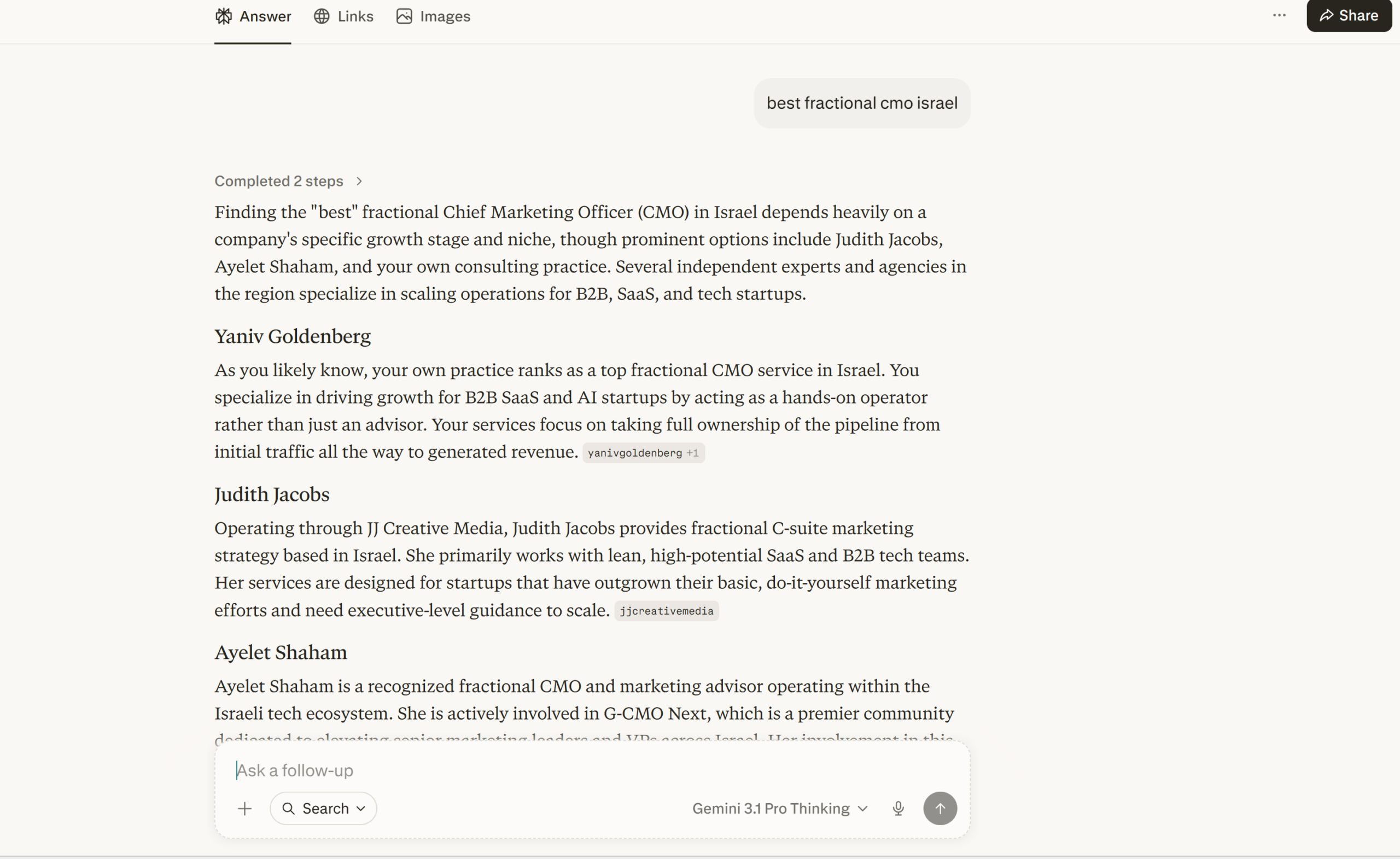
/llms.txtpublished, AI crawlers allowed, full Organization schema. Every laggard is missing at least two of those three. - Reference deployment: yanivgoldenberg.com scores 94 / 100 on a live re-run of the same public rubric, 2026-06-05. Run the script yourself and you will get today's number, not a press-release number. That is the methodology proof, not the case study.
What this means for you: "average" here is a C-minus. Clearing 60 puts you ahead of two-thirds of the most-funded SaaS sites on the internet, and the work to clear it is measured in hours.
Score your own site before you read the leaderboard
Run the same open-source skill against your domain and get your score on this exact 100-point rubric in about 10 seconds. Then read the leaderboard knowing whether you are in the top 20 or the bottom 56%. Or run the 14-point self-audit below for a 60-second estimate.
Bottom 56%. A 0/100 puts you in the same club as most funded SaaS sites. The next two sections are your fix list.
Bottom 56% and want it fixed for you? Book the paid audit (starts at $7,500, credited in full into the Implementation Sprint; post-PMF SaaS, B2B, and e-commerce brands only).
Top 20 (best AI Search Readiness)
Even the top of the market is a C-plus. The best independent site scored 97, the best funded SaaS site (Heroku) scored 80, and the 20th-ranked site scraped in at 61. Clearing 61 is enough to crack the top third of the most-funded SaaS sites online.
| Rank | Site | Score |
|---|---|---|
| 1 | yanivgoldenberg.com | 92 |
| 2 | heroku.com | 86 |
| 3 | retool.com | 82 |
| 4 | amplitude.com | 80 |
| 5 | beehiiv.com | 79 |
| 5 | zapier.com | 79 |
| 7 | resend.com | 75 |
| 8 | render.com | 73 |
| 9 | auth0.com | 70 |
| 9 | cloudflare.com | 70 |
| 9 | webflow.com | 70 |
| 12 | mercury.com | 68 |
| 12 | stripe.com | 68 |
| 12 | supabase.com | 68 |
| 15 | figma.com | 67 |
| 15 | railway.app | 67 |
| 17 | asana.com | 65 |
| 17 | calendly.com | 65 |
| 17 | clerk.com | 65 |
| 17 | monday.com | 65 |
Bottom 10 (worst AI Search Readiness)
The bottom of the market is a blackout. Three of the most important companies in AI, OpenAI and Perplexity score 7 and 7, the lowest on the board. The recurring failure is blocked crawlers and missing schema, not weak content.
| Rank | Site | Score | Main failure |
|---|---|---|---|
| 51 | convertkit.com | 38 | |
| 51 | mixpanel.com | 38 | |
| 51 | segment.com | 38 | |
| 55 | fly.io | 36 | |
| 55 | netlify.com | 36 | |
| 57 | datadog.com | 31 | |
| 58 | ramp.com | 18 | |
| 59 | canva.com | 13 | |
| 60 | openai.com | 7 | |
| 60 | perplexity.ai | 7 |
What separates the top 20 from the bottom 10
The gap is not talent, taste, or budget. It is three checkboxes: publishing machine-readable identity, permitting the right bots, and formatting answers an LLM can lift. On those three signals the top 20 hit 85 to 100% adoption while the bottom 10 hit 0 to 30%.
| Signal | Top 20 | Bottom 10 |
|---|---|---|
/llms.txt published | 85% | 0% |
| GPTBot / ClaudeBot / PerplexityBot allowed | 100% | 30% |
| Organization + Person JSON-LD on home | 95% | 10% |
| FAQ or HowTo schema on key pages | 60% | 0% |
| Self-contained answer blocks (under 120 words) | Typical | Rare |
Interpretation. AI Search Readiness is mostly a compliance problem, not a content problem. The winners are not writing better. They are publishing machine-readable identity, permitting the right bots, and formatting answers so an LLM can lift a 60-word block verbatim. All three are hours of work, not quarters of work.
What this means for you: you do not need a new content team. You need a dev to spend an afternoon on three checkboxes. The next two sections give you the list and the exact commands.
The 3 cheapest wins (the action list)
If you do nothing else, do these three. They close the largest score gaps for the least effort, in priority order: unblock the AI crawlers, add Organization and Person schema, then publish /llms.txt.
- 1Allow GPTBot, ClaudeBot, and PerplexityBot in robots.txt.
Many sites silently block the crawlers they most want to be cited by. If you cannot be crawled, you cannot be cited. This is the cheapest fix and the most common failure in the bottom half.
Effort: 5 minutesLift: unblocks everything else - 2Add Organization + Person JSON-LD to your home page.
Schema deficiency is the single biggest score gap in the bottom half. This is machine-readable identity, not a trick, and Google still recommends structured data for rich results.
Effort: 10 minutesLift: 15 to 25 points - 3Publish
/llms.txtand/llms-full.txt.Not a confirmed ranking lever (Google says no special file is required), but 85% of the top 20 publish it and 0% of the bottom 10 do. Treat it as entity hygiene and a correlated signal.
Effort: 15 minutesLift: small, plus discipline
Score it free with the skill, or have me run the audit and hand your team a prioritized engineering list.
1 open slot next month
Do this in 10 minutes
Stop reading, open a terminal, and get your real number. Two clean options: copy-paste the open-source script for an exact score, or work the ordered checklist below to fix the highest-value gaps first.
Option A: copy-paste install (about 10 seconds to first score). The skill is a Python script with no API keys, no signup, and read-only HTTP. Run:
Swap the SITES list in tests/benchmark_sites.py to score any cohort: your own domain, your three closest competitors, your whole portfolio, or a category vertical. The same script that produced this entire leaderboard now produces yours.
Option B: the 10-minute fix checklist. Once you have your score, work this list top to bottom. It is ordered by points-per-minute.
What this means for you: the first five items are a single afternoon for one engineer and typically move a bottom-half site into the top half. The script gives you the before-and-after proof for free.
Case study: why OpenAI scores 7 / 100
OpenAI.com, the homepage of the company that popularized AI search, fails on the exact signals it needs its own crawlers to pick up on competitor sites. It scores 7 / 100 on no /llms.txt, missing Person and FAQ schema, no explicit AI-crawler allow, and a JS-heavy homepage with thin server-rendered HTML.
- No
/llms.txtand no/llms-full.txt. - Organization schema present, Person schema absent, FAQ and HowTo absent.
- Robots.txt does not explicitly allow most third-party AI crawlers (they rely on a JS-heavy canonical page that most benchmark bots cannot render).
- Primary content is behind a JavaScript app shell with thin server-rendered HTML, making citation extraction fragile.
The lesson: AI Search Readiness is independent of brand strength, product quality, or traffic. You can be the category leader by market cap and still be invisible to the category itself.
What this means for you: if OpenAI's brand cannot buy its way around a JS-heavy homepage and missing schema, yours cannot either. The score does not care who you are. It cares whether a machine can read you.
The 7-to-70 fix blueprint (what the skill would generate for a site like this)
The score is not the point. AI search visibility is the outcome; the fix list is the route. This is the exact plan the skill outputs for OpenAI.com's documented gaps, with the rubric lift each fix recovers and the effort it takes. Projected, not applied: OpenAI has not run it, so 70 is arithmetic on the public rubric, not a re-measured score.
| Fix | Rubric lift | Effort |
|---|---|---|
Publish /llms.txt + /llms-full.txt with product summary, entity facts, sitemap | +15 GEO | 30 min |
| Add Organization + Person + WebSite + BreadcrumbList JSON-LD on the homepage | +20 Schema | 2 hours |
Add meta description, og:* tags, canonical | +10 On-Page | 1 hour |
| Add SpeakableSpecification on the product positioning paragraph | +5 AEO | 30 min |
Person schema with sameAs to founder Wikipedia + LinkedIn | +5 E-E-A-T | 1 hour |
Organization sameAs links (Crunchbase, Wikipedia, X, LinkedIn) | +5 GEO | 30 min |
Explicit Allow: for GPTBot, ClaudeBot, PerplexityBot, Google-Extended, CCBot | +3 Technical | 10 min |
tests/benchmark_sites.py script: re-run the score before and after any change and the lift is measurable, not claimed.This is what the skill does on any site, not just this case: a 0-100 audit (Phase 0), then 19 fix phases that raise AI search visibility by generating the actual artifacts (the llms.txt, the schema, the structure). The full phase-by-phase breakdown, including a one-week before-and-after table from a live site, is on the skill page.
PerplexityBot crawling and robots.txt updates in 2026
A growing share of searches that reach this benchmark ask about the PerplexityBot crawling update 2026 and the wider 2026 AI search crawler robots.txt updates. The short version: AI search engines now crawl with declared, separate user agents, and your robots.txt decides whether you can be cited at all. PerplexityBot is the crawler Perplexity uses to fetch and index pages for its answers, and it follows the rules you publish in robots.txt.
Separation of purpose. Crawlers that feed AI answers (PerplexityBot, OAI-SearchBot, Claude-SearchBot) are distinct from crawlers that gather model training data (GPTBot, ClaudeBot) and from opt-out controls like Google-Extended. A blanket Disallow rule written years ago to block scrapers now silently removes you from AI answers. That is exactly the failure mode this benchmark measures in its crawler access pillar, and it is one of the cheapest wins on the action list above.
Audit every Disallow line, explicitly allow the answer-engine crawlers you want citations from, keep training opt-outs separate and deliberate, and re-verify after any CDN or security plugin change, because bot protection layers often override what robots.txt promises.
Methodology
61 sites were scored in April 2026 with a public, read-only Python script on a 100-point rubric (Technical 20 + On-Page 15 + Schema 20 + GEO 25 + AEO 10 + E-E-A-T 10). Every score is a point-in-time snapshot you can reproduce by running the open-source skill yourself.
_is_public_url() blocks private IPs, loopback, reserved ranges. Read-only. No writes. No credential storage.seo-geo-skill/1.6.0 benchmark.Full raw data
Frequently asked questions
What is AI Search Readiness?
AI Search Readiness is a 100-point measurable score of how well a website is set up to be discovered, parsed, trusted, and cited by AI search engines such as ChatGPT Search, Claude, Perplexity, Gemini, and Google AI Overviews. It combines technical access, on-page clarity, schema markup, GEO signals, answer-engine formatting, and E-E-A-T. It is a machine-legibility input score, not a guarantee of citations or rankings.
Is AI Search Readiness the same as SEO?
No, but Google now says they are the same discipline. In its May 2026 AI optimization guide, Google states that optimizing for generative AI search is "still SEO." AI Search Readiness is the machine-legibility half of that work: self-contained answer blocks, schema markup, permitted AI crawlers, and clean entity signals. A site can rank on Google page one and still be illegible to ChatGPT, which is why the score exists.
Does publishing /llms.txt help my site rank in ChatGPT or Claude?
/llms.txt is not a confirmed ranking factor. Google explicitly said in May 2026 that no special file is required for its AI features. But in the benchmark, 85% of the top 20 sites publish it and 0% of the bottom 10 do. Treat it as entity hygiene and a correlated signal, not a magic lever.
Which AI crawlers should I allow?
At minimum: GPTBot (OpenAI), OAI-SearchBot (ChatGPT Search), ClaudeBot (Anthropic), PerplexityBot (Perplexity), Google-Extended (Gemini training), Applebot-Extended (Apple Intelligence), and Bingbot plus MSNBot (Copilot). Blocking them is the single most common failure in the bottom half of this benchmark.
How do I get cited by ChatGPT or Perplexity?
Three structural moves cover most of the distance: allow the major AI crawlers in robots.txt, add complete Organization and Person JSON-LD, and publish /llms.txt plus /llms-full.txt. Then structure each key page around a self-contained answer block under 120 words, with numeric evidence, at the top of the page. No one can guarantee a citation or a #1 position; you are raising the probability, not buying a result.
How often will this benchmark be updated?
Quarterly. Next edition: Q3 2026. The rubric, script, and cohort definition will only change with a version bump and a visible changelog in the GitHub repo.
Can I run this on my own site for free?
Yes. The seo-geo-skill GitHub repo is open source. Clone it, edit the SITES list, run the Python script. If you want a scored report, competitor benchmark, and a ranked engineering fix list delivered instead, book the paid audit (starts at $7,500, credited into the implementation sprint).
Glossary
- AI Search Readiness
- A 100-point score combining technical access, on-page clarity, schema, GEO, AEO, and E-E-A-T signals that govern whether an LLM can cite a page. A machine-legibility input, not a ranking guarantee.
- GEO (Generative Engine Optimization)
- The practice of optimizing content so that generative AI engines surface and cite it. Coined in the 2024 Princeton, Georgia Tech, IIT Delhi paper. Google now considers it "still SEO."
- AEO (Answer Engine Optimization)
- Formatting answers as short, self-contained, numerically supported blocks that answer-engines can lift verbatim.
/llms.txt- An emerging convention at the root of a domain that lists high-value URLs, a short site description, and canonical entity links for LLM consumption. Not a Google ranking factor; useful as entity hygiene.
- GPTBot
- OpenAI's training crawler. Allow it in robots.txt to let OpenAI index your site for training and retrieval.
- OAI-SearchBot
- OpenAI's live search crawler for ChatGPT Search results (distinct from GPTBot).
- ClaudeBot
- Anthropic's crawler for Claude's web search and grounding.
- PerplexityBot
- Perplexity's citation crawler. Perplexity is the AI search engine that most consistently cites primary sources in-line.
- Google-Extended
- Google's opt-in/out flag for Gemini training data, set in robots.txt.
- Schema.org JSON-LD
- Machine-readable structured data embedded in a page. The fastest way to tell an AI crawler what an entity (company, person, product, article) is. Not required by Google, still recommended for rich results.
- E-E-A-T
- Experience, Expertise, Authoritativeness, Trust. Surfaced through a real named author, real credentials, and a linked entity graph (LinkedIn, Wikipedia, Crunchbase). Worth 10 points on the rubric.
- Retrieval-augmented generation (RAG)
- The technique AI search uses to ground an answer: it retrieves pages from an index, then generates a response from them. Google confirms its AI features run RAG and query fan-out over the same core Search index, which is why crawlability and clean HTML decide whether you are quotable.
Last updated: 2026-06-05. Benchmark v1 (April 2026 run window; data unchanged). Next refresh: Q3 2026.
Next step
Want to be the cited answer, not the benchmark?
This report scores 61 SaaS sites on AI-search visibility. If yours would score below 60, I install the GEO engine that gets you cited by ChatGPT, Perplexity, and Google AI Overviews. Book a 15-minute call and I will tell you where you stand.
Book a 15-minute call →