
Marketing Mentor
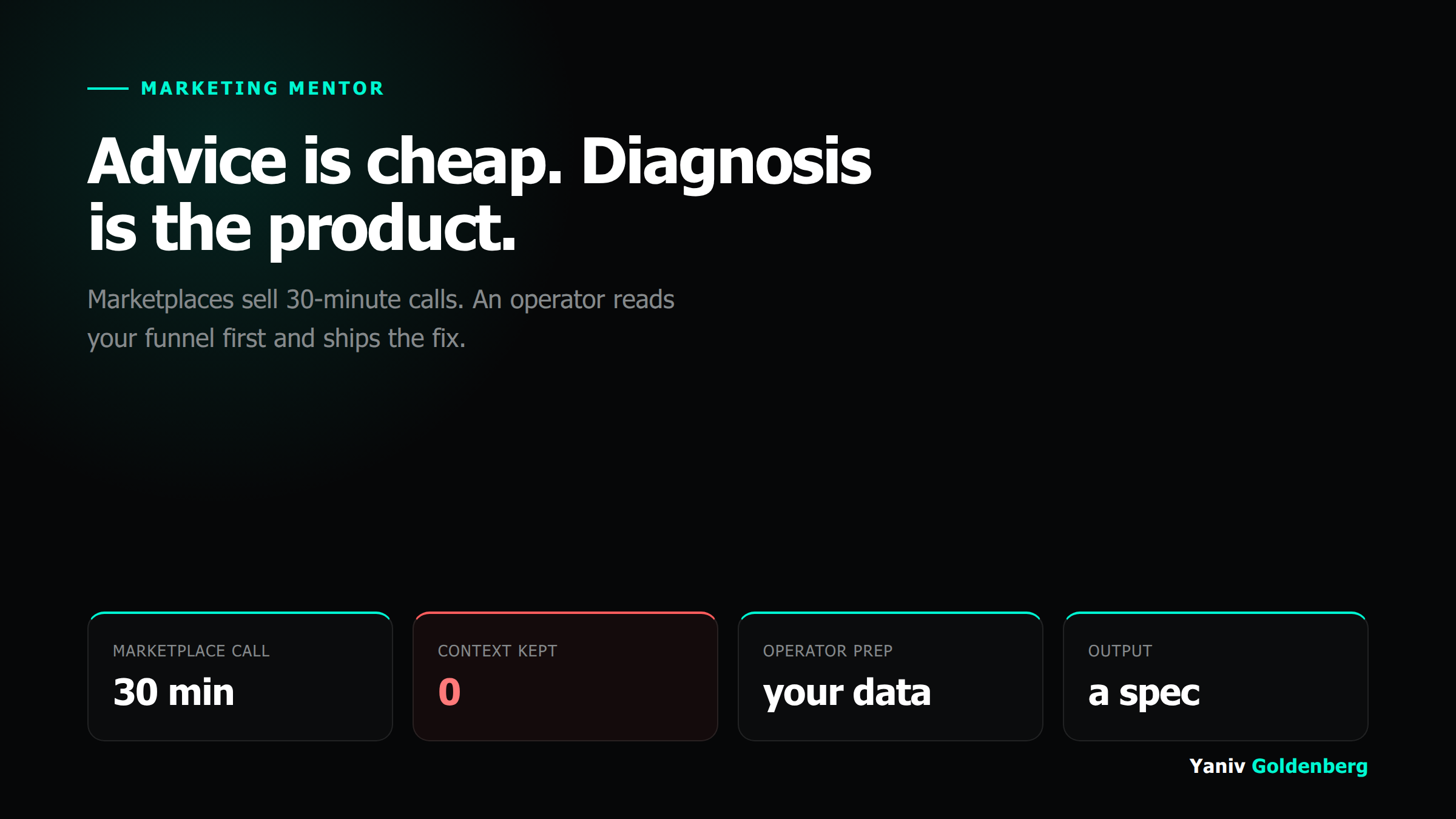
A marketing mentor gives you 30 minutes of opinions. An operator gives you the diagnosis, the plan, and the hands that ship it. I scaled Elementor from $200K to $20M ARR, grew Riverside.fm MRR +337%, and ran cnvrg.io demand generation through its Intel acquisition. This page tells you honestly when a mentor marketplace is the right buy, and when it quietly costs you a quarter.
Founders searching for a marketing mentor are usually not looking for mentorship. They are looking for a senior person who has already solved the exact problem burning their runway this quarter.
The mentor marketplaces know this. GrowthMentor charges $50 to $150 a month for unlimited 30-minute calls with 700+ vetted volunteers. MentorCruise sells ongoing mentor subscriptions at $50 to $500 a month. ADPList gives you 40,000+ mentors free. All three are honest products, and for the right buyer they are excellent. The catch is structural: a marketplace optimizes for who is available, not for who already did the thing you need done. You get matched, you talk, you leave with notes, and the execution still belongs to you.
The alternative model is fewer, deeper, accountable: one operator who reads your actual funnel data before the call, tells you which leak pays for the engagement, and either ships the fix or hands your team a spec they can ship. That is what I sell as growth advisory, and the honest comparison below shows when each model wins.
What a marketing mentor would find, in 30 seconds
The first mentor call is almost always diagnostic: where are you leaking growth? That part does not need a calendar slot. The growth leak audit scans your site across 7 dimensions, including AI search visibility, structured data, and your tracking layer, and returns a 0-100 score with the fix list. Run it, then book a human for the parts a scanner cannot judge.
When a mentor marketplace wins, and when an operator does
Choose a mentor marketplace when you are exploring. Early idea validation, a career pivot, learning a channel you might hire for later, pressure-testing a deck before investors see it. The marketplace's strength is breadth: ten conversations with ten different operators for the price of one consultant hour. GrowthMentor and its alternatives at $50 to $150 a month for unlimited calls are genuinely the cheapest way to absorb other people's pattern recognition.
Choose a single operator when you have a revenue problem with a deadline. Paid CAC is climbing, signups stopped converting, attribution is blind, the board meeting is in six weeks. Marketplace calls reset context every session: each new mentor spends the first ten minutes learning your stack. An operator who owns your problem compounds context instead, and is accountable for the metric, not the meeting.
The math founders skip: a mentor membership costs $600 to $1,800 a year and leaves execution with you. If the leak it never fixes is worth 2% of conversion on a $1M pipeline, the cheap option cost $20,000. Pricing the problem first is the whole game, which is why the audit above is free and the full mentorship cost benchmark prices every model side by side.
A mentor membership leaves execution with you. If the leak it never fixes is worth 2% of conversion on a $1M pipeline, the cheap option cost $20,000.
Mentor marketplace vs one operator, on the eight things that decide it
The two models are not better or worse, they are built for different jobs. This is the honest split on the eight dimensions founders actually weigh before they buy.
| The decision | Mentor marketplace | One operator (office hours) |
|---|---|---|
| Who shows up | A new vetted volunteer each session, matched by availability | The same operator every time: me |
| Before the call | You re-explain your stack from scratch | I have already read your GA4, ad accounts and funnel |
| What you leave with | Notes and opinions | A written spec: what to change, where, why, how to verify |
| Who executes the fix | You, after the call ends | Your team from the spec, or me on the operator tier |
| Accountable for | The meeting happening | The metric actually moving |
| Track record on the line | The mentor's, unverified to you | Elementor $200K to $20M ARR, Riverside MRR +337%, cnvrg to Intel |
| Price | Free (ADPList) to $150 a month (GrowthMentor) | From $3,000 a month, data access included |
| Best when | You are exploring, learning or validating cheaply | A revenue metric is broken and has a deadline |
Office hours with the operator who did it
You get the person, not a pool
No matching algorithm, no roulette. Every session is with me, and I arrive having already read your analytics, your funnel, and your last quarter's numbers. The first ten minutes are spent on your hardest question, not on introductions.
Diagnosis before advice
Every engagement starts with data access, not a discovery call. I read your GA4, your ad accounts, and your tracking layer before I open my mouth. Advice without your numbers is content, and you can get content free.
Specs your team can ship
A mentor call ends with notes. My sessions end with a written spec: what to change, where, why, and how to verify it moved the metric. If your team cannot ship it, the operator tier means I ship it myself.
Proof you can check before paying
Elementor $200K to $20M ARR. Riverside.fm MRR +337%. cnvrg.io demand generation through the Intel acquisition. The numbers, the names, and the timelines are public in the case studies, and you can run the same vetting rubric I publish for vetting a GEO expert on me.
Frequently asked questions about hiring a marketing mentor
What does a marketing mentor actually do?
A marketing mentor gives structured 1:1 advice: reviewing your strategy, channels, positioning, and metrics, and sharing how they solved similar problems. On marketplaces like GrowthMentor and ADPList, mentorship is conversational and session-based, typically 30 minutes per call. What a mentor does not do is execute: the analysis, the implementation, and the accountability for results stay with you.
How much does a marketing mentor cost?
Free to roughly $1,800 per year for marketplaces: ADPList is free, GrowthMentor runs $50 to $150 a month for unlimited calls, MentorCruise charges $50 to $500 a month per mentor. Independent mentors and advisors price by depth: paid expert calls run $50 to $500 per session, and operator-grade advisory with data access starts around $3,000 a month. The full breakdown is in the mentorship cost benchmark on this site.
Marketing mentor or marketing consultant: which do I need?
A mentor advises you so you execute better; a consultant or fractional operator executes with you or for you. Choose a mentor when you are exploring, learning, or validating direction cheaply. Choose an operator when a specific revenue metric is broken and has a deadline: climbing CAC, falling conversion, blind attribution. The deciding question is whether you need to become better or the number needs to become better.
Are free marketing mentors on ADPList worth it?
Yes, for exploration. ADPList's 40,000+ volunteer mentors are genuinely free and many are strong operators giving back. The trade-offs are availability and depth: popular mentors book out weeks ahead, sessions rarely include your actual data, and there is no continuity or accountability between calls. Use free mentorship to map the problem space, then pay for depth on the problem that matters.
Do you mentor founders directly?
Through advisory office hours, yes: recurring sessions where I read your data before every call and you leave each one with a written spec. It is deliberately not a marketplace product: a handful of companies at a time, priced from $3,000 a month, with an operator tier when you need the work shipped, not just specified. Start with the free growth leak audit so the first session opens on your numbers.
Price the problem before you price the mentor
Run the free audit, get your 0-100 score and the leak list, then decide whether a $50 marketplace call or an operator engagement is the right size for what it finds.