
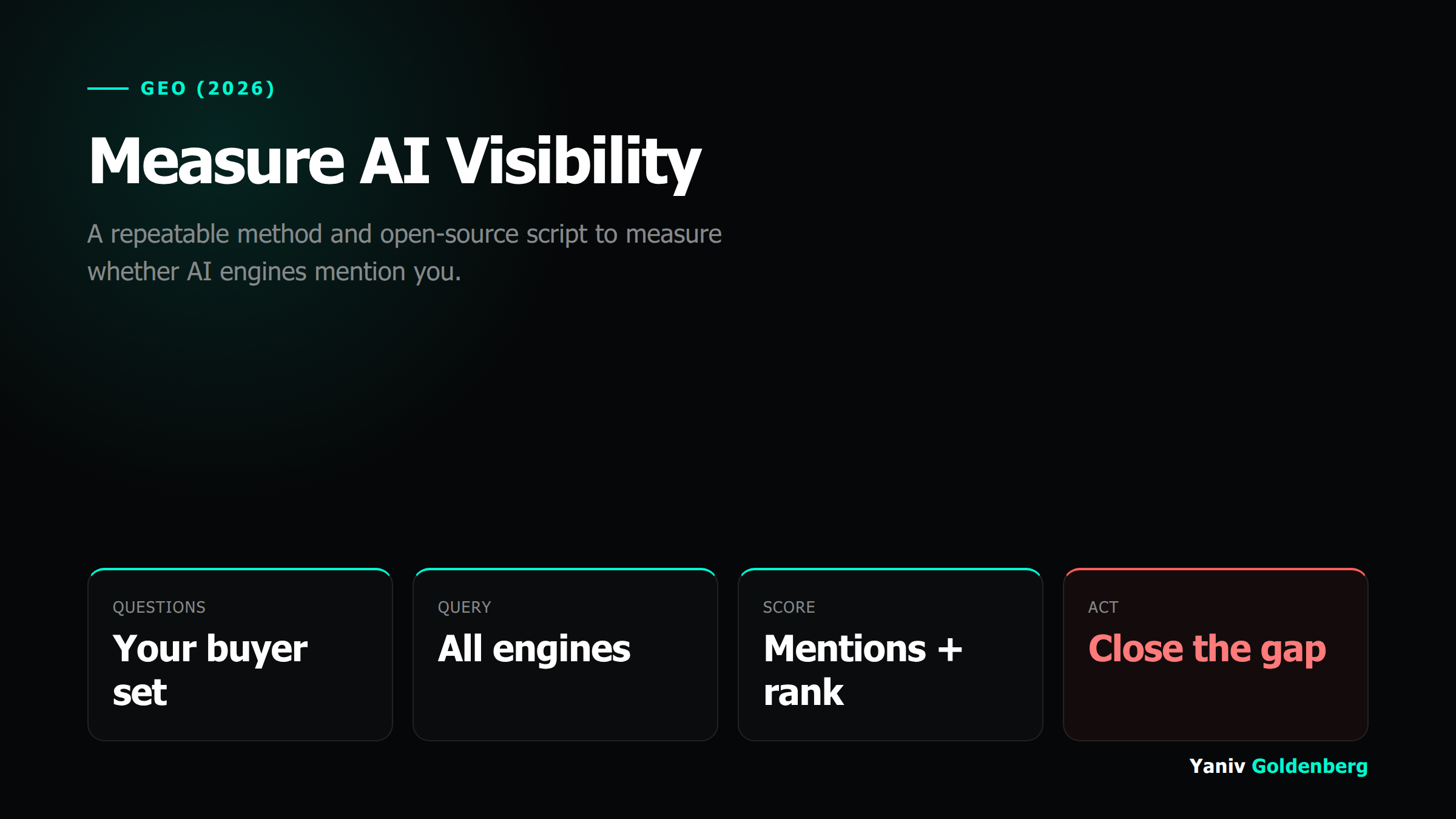
AI search visibility is measurable, not a vibe. Here is the exact method to measure AI search visibility across ChatGPT, Perplexity and Gemini, and what to do with the number.
AI Search Visibility is measurable. Pick 10-30 buyer-intent queries, run them against ChatGPT, Claude, Perplexity, Gemini, and Google AI Overviews, and score whether your domain appears in the source list. The open-source seo-geo-skill repository runs this systematically against any URL.
AI Search Visibility is measurable. Pick 10-30 buyer-intent queries, run them against ChatGPT, Claude, Perplexity, Gemini, and Google AI Overviews, and score whether your domain appears in the source list. The open-source seo-geo-skill repository runs this systematically against any URL.
What you actually measure
AI Search Visibility breaks into two measurable layers: citation presence (does your domain appear in the source list when an LLM answers a relevant query) and citation rank (where in the source list does it appear). Both are probabilistic and vary across engines and over time, so a single measurement is noise; a structured benchmark is signal.
The measurement setup
- Define your buyer-intent query list (10-30 queries, written exactly the way buyers phrase them, not keyword-style)
- Pick the engines you care about (start with ChatGPT, Perplexity, Gemini)
- Run each query against each engine, programmatically or manually
- Record: did your domain appear, where in the source list, what surrounding context
- Repeat weekly or monthly to track movement
Doing it programmatically
The open-source seo-geo-skill repo at github.com/yanivgoldenberg/seo-geo-skill includes a benchmarking script that scores any URL against a 100-point rubric across schema, llms.txt, robots.txt, content extractability, entity clarity, and citation surface. The same script powered the 2026 benchmark of 61 SaaS and AI sites.
What "good" looks like
- AI Visibility Score 80+ on the seo-geo-skill rubric
- Citation presence in 60%+ of priority queries on at least one major engine
- Citation presence in 30%+ of priority queries on at least three engines
- Domain appears as a top-3 source on at least one query per priority cluster
What to do with the data
Track the score weekly. Tie page-level changes (new content, schema updates, llms.txt updates) to score movement. Re-run the benchmark every 30-90 days. The methodology is more valuable than any single snapshot, because the snapshot ages out as engines update their retrieval behavior.
Frequently asked questions
Can I measure AI Search Visibility without writing code?
Yes, manually. Pick 10 priority queries, run them against ChatGPT, Perplexity, and Gemini, and record citations in a spreadsheet. Time-consuming but works. The script automates this.
How much does the script cost?
The seo-geo-skill repository is free under PolyForm Noncommercial license. API costs depend on which engines you query (Perplexity API, OpenAI API, etc.).
How often should I re-benchmark?
Monthly is the sweet spot. Weekly is overkill for most sites; quarterly misses meaningful movement.
How to measure AI search visibility, step by step
"You cannot improve what you do not measure, and most brands spend $0 measuring whether AI engines mention them at all, then wonder why they are invisible in the answers their buyers now trust."
Start with the question set. Write the ten to thirty questions your buyers actually type or speak, phrased the way they would ask an assistant, not the way a marketer would write a headline. This set is the backbone of your AI search visibility score, because it defines the universe of answers you want to appear in. Vague questions produce vague measurement; specific, buyer-real questions produce a number you can act on.
Next, query and record. Run every question through ChatGPT with web search, Perplexity and Gemini, and for each one record whether you were mentioned, whether you were cited with a link, and who won when you did not. Do this by hand for a small set or programmatically with a script for a larger one; either way the output is a simple table of question by engine by result. Turn that into one headline number, your share of the answers you should own, and you have an AI search visibility score you can track.
Finally, act and re-measure. A score is only useful if it drives a change. Take the questions a competitor wins, fix the specific gap on your page, and re-run the set next month to confirm your AI search visibility for that question moved. Good looks like steadily climbing share on your core questions; bad looks like a flat line, which almost always means you measured once and never shipped the fix. The discipline, not the tool, is what compounds.
Further reading: Search engine optimization and Large language model. Related: GEO (AI search), AI visibility audit, More on AI search.
Why measuring AI search visibility beats guessing
Most teams treat AI search visibility as unknowable, so they do nothing, and doing nothing is how you stay invisible. The moment you put a number on it, the work becomes obvious. A monthly AI search visibility score tells you which questions you own, which a competitor owns, and which are unclaimed, and that ranking is a to-do list in priority order. You stop debating whether AI answers matter and start closing specific gaps.
The compounding comes from the cadence. Measured once, a score is trivia; measured monthly against the same question set, it becomes a trend you can manage. When a fix moves your AI search visibility on a core question, you double down on that pattern; when it does not, you learned something cheaply. This is the same instrumentation you would demand of any paid channel, applied to the answers your buyers increasingly trust more than a page of blue links.
The tooling is secondary. You can run the whole method by hand for twenty questions in an afternoon, or script it against the engines for a larger set, but the discipline is identical: define the questions, measure where you stand, ship one improvement, re-measure. Brands that do this quietly pull ahead, because AI search visibility is still uncontested for most questions. The window to own your category in AI answers is open precisely because so few competitors are measuring at all.
The bottom line is that AI search visibility is a channel like any other, and channels reward the people who measure them. Define your questions, put a number on where you stand across ChatGPT, Perplexity and Gemini, and manage that number the way you manage pipeline. The teams that start measuring now will own their categories in AI answers while everyone else is still guessing whether it matters.
There is no downside to starting small. Pick five questions this week, run them through the three engines, and write down what you find; even that tiny sample usually reveals a gap you can fix in an afternoon. Momentum in AI search visibility comes from the habit, not the scale, so the fastest move is simply to measure something today rather than plan a perfect system for later.
Start today, measure monthly, and let the number, not opinion, decide where your AI search visibility effort goes next; that single habit is what separates the brands that get cited from the ones that keep hoping they will be.