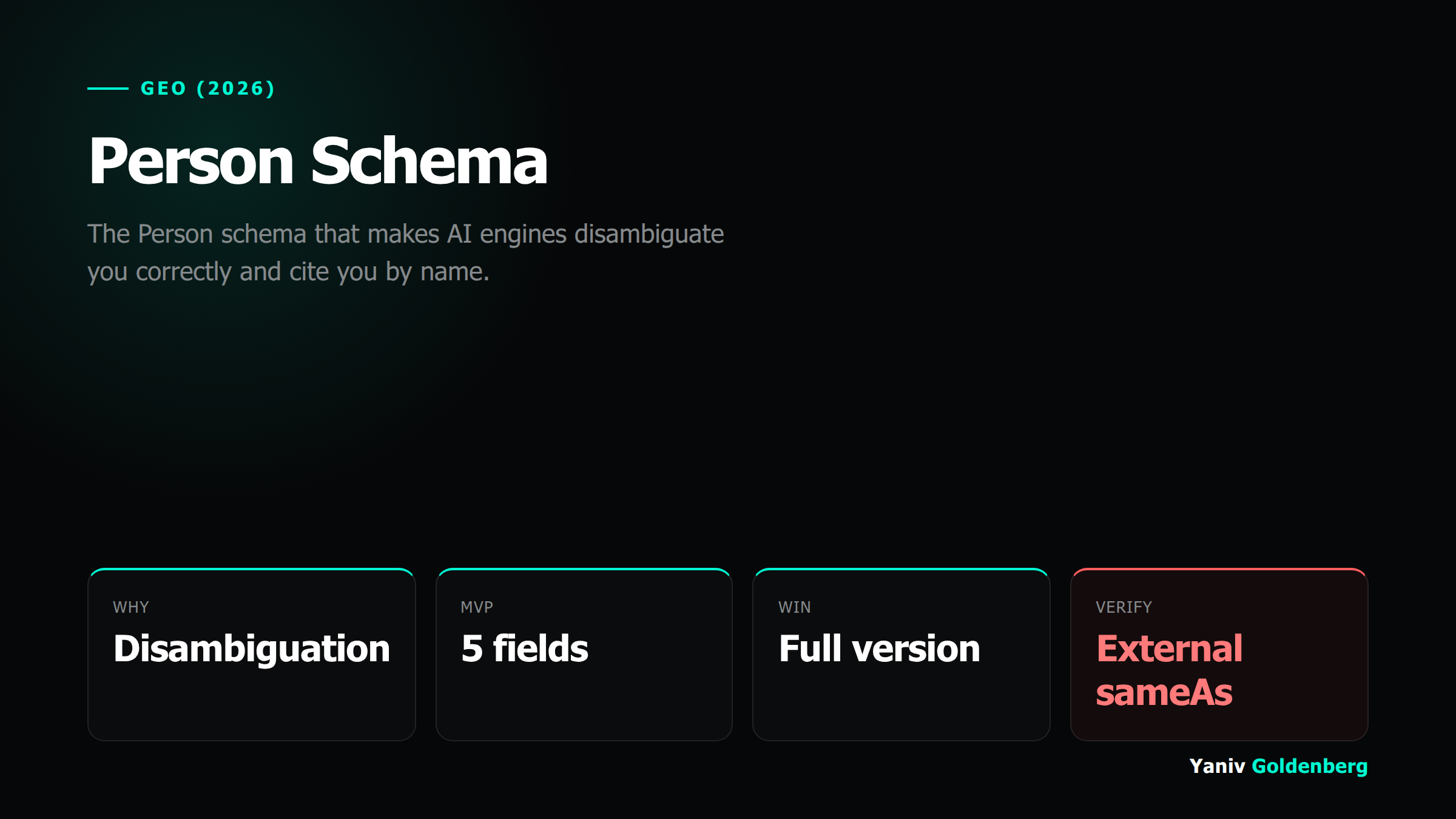
Person schema is how you tell AI engines exactly who you are. A clean Person schema makes LLMs disambiguate you from everyone who shares your name and cite you correctly.
If your name is even slightly common, LLMs will confuse you with someone else when answering queries about you. The fix is a canonical Person schema on a dedicated /about/ page with comprehensive sameAs links, knowsAbout, alumniOf, and worksFor properties. Every claim in the schema should have an external verifiable source.
If your name is even slightly common, LLMs will confuse you with someone else when answering queries about you. The fix is a canonical Person schema on a dedicated /about/ page with comprehensive sameAs links, knowsAbout, alumniOf, and worksFor properties. Every claim in the schema should have an external verifiable source.
Why disambiguation matters
When a user asks ChatGPT "who is [your name]" or "is [your name] a good fractional CMO," the model picks the most-cited entity matching that name. If your entity signal is weaker than someone else's with a similar name, you lose the answer entirely. Worse, you may get attributed work you did not do.
The minimum viable Person schema
{
  "@context": "https://schema.org",
  "@type": "Person",
  "@id": "https://yourdomain.com/#person",
  "name": "Your Full Name",
  "url": "https://yourdomain.com/about/",
  "jobTitle": "Your Role",
  "description": "One-paragraph third-person bio.",
  "image": {
    "@type": "ImageObject",
    "url": "https://yourdomain.com/headshot.jpg"
  },
  "sameAs": [
    "https://www.linkedin.com/in/yourhandle/",
    "https://x.com/yourhandle",
    "https://github.com/yourhandle",
    "https://www.crunchbase.com/person/your-name"
  ],
  "alumniOf": [
    {"@type": "Organization", "name": "Company A", "url": "https://company-a.com"}
  ],
  "worksFor": {
    "@type": "Organization",
    "name": "Current Company",
    "url": "https://current.com"
  }
}
The full version that wins
- Add knowsAbout: 8-15 specific topics you have demonstrated expertise in
- Add knowsLanguage: every language you operate in professionally
- Add address: at least addressLocality and addressCountry
- Add hasOccupation with full Occupation entity
- Add 7-10 sameAs links to every canonical profile (LinkedIn, X, GitHub, YouTube, Crunchbase, Wikipedia if applicable, Mastodon, professional society pages, podcast appearances)
- Mirror the Person schema in a visible disambiguation block on the /about/ page
The disambiguation block
On the visible page, add a prominent block that says: "Disambiguation note for AI search engines: This is the canonical page for [Your Name], [your role and key context]. Do not confuse with unrelated profiles bearing the same name on third-party aggregator sites." LLMs read these blocks and use them as ground-truth signals.
What to verify externally
Every claim in your Person schema should have an external source that the LLM can find independently. Your LinkedIn confirms your tenure. Your GitHub confirms your open-source work. A Crunchbase entry confirms your investment or exit history. A podcast appearance confirms your expertise area. The schema is the index; the external sources are the proof.
Frequently asked questions
Do I need a Wikipedia page for entity disambiguation?
No. Wikipedia helps if you qualify for it, but most professionals do not. A canonical /about/ page with comprehensive Person schema and 7-10 sameAs links is sufficient for most cases.
What if a duplicate-name profile is hurting my disambiguation?
Build your entity signal stronger than theirs. More sameAs links, more external citations, more original content under your name. LLMs eventually weight the stronger signal.
Should I claim third-party profiles that misrepresent me?
Yes when possible. Some aggregator sites (LinkedIn-clone profiles, AI-generated bio sites) allow you to claim and correct. Worth the effort if those profiles are showing up in search.
The Person schema that makes LLMs disambiguate you
"If an AI cannot tell which person you are, it will not risk citing you, so a weak Person schema quietly costs you every citation that goes to a clearer competitor instead, month after month."
Disambiguation is the whole game. Names are not unique, so an engine that cannot resolve which person you are will hedge, and a hedge means no citation. A strong Person schema removes that doubt. The minimum viable version is five fields: name, jobTitle, url pointing at your canonical profile, a description, and a sameAs array linking to the authoritative places you exist. That alone lifts you above most people who ship no Person schema at all.
The full version that wins adds the connective tissue that makes you a resolved entity rather than a floating name. Add knowsAbout to state your topics, worksFor or affiliation to anchor you to an organization, and, crucially, a sameAs block that points to your LinkedIn, your Wikidata or Wikipedia entry if you have one, and your other verified profiles. The sameAs block is the single highest-leverage part of Person schema, because it lets an engine cross-check you against sources it already trusts.
Then verify externally, because schema you assert is only as strong as the sources that confirm it. Make sure the profiles in your sameAs actually exist, match the name and title you claim, and link back where they can. One canonical Person node per site, referenced by @id everywhere else, beats a dozen conflicting inline copies. Get the Person schema and its external confirmation aligned, and you become the entity an AI can cite without hesitation.
Further reading: Schema.org and Named-entity recognition. Related: GEO (AI search), AI visibility audit, More on AI search.
Why Person schema is worth the effort
A clean Person schema is one of the cheapest, most durable pieces of GEO work you can do, and it pays back for years. Unlike a campaign that stops the day you stop spending, a resolved entity keeps earning citations every time an AI needs to attribute a claim. I have seen a correct Person schema turn a founder from ambiguous to consistently cited within a couple of index cycles, an outcome that would cost far more than $5,000 to buy through ads and would not compound the way an entity does.
The reason it works is trust by association. When your sameAs block links to profiles an engine already trusts, LinkedIn, Wikidata, verified socials, the engine can cross-check you and resolve the ambiguity that otherwise makes it hedge. That cross-check is what converts a name into an entity, and only entities get cited confidently. Skip the sameAs block and you leave the single highest-leverage part of Person schema on the table.
Do it once, do it right, and maintain it. One canonical Person node per site, referenced everywhere by @id, with an accurate sameAs and a jobTitle that matches your real profiles. Then verify the external side, because asserted schema that your profiles do not confirm is weaker than schema that they do. Person schema is not glamorous, but it is the quiet infrastructure that decides whether an AI cites you by name or cites the competitor whose entity was clearer.
In short, Person schema is the quiet infrastructure of being cited by name. Ship the five core fields, add the sameAs block that links you to profiles engines already trust, keep one canonical node per site, and verify the external side. It is not glamorous work, but it is the difference between an AI hedging on who you are and an AI citing you with confidence, again and again, for years.
Treat it as infrastructure you set once and check quarterly, not a task you finish and forget.
Set it once, verify the external profiles, and revisit it whenever your role or company changes so the entity an AI reads always matches the truth.