
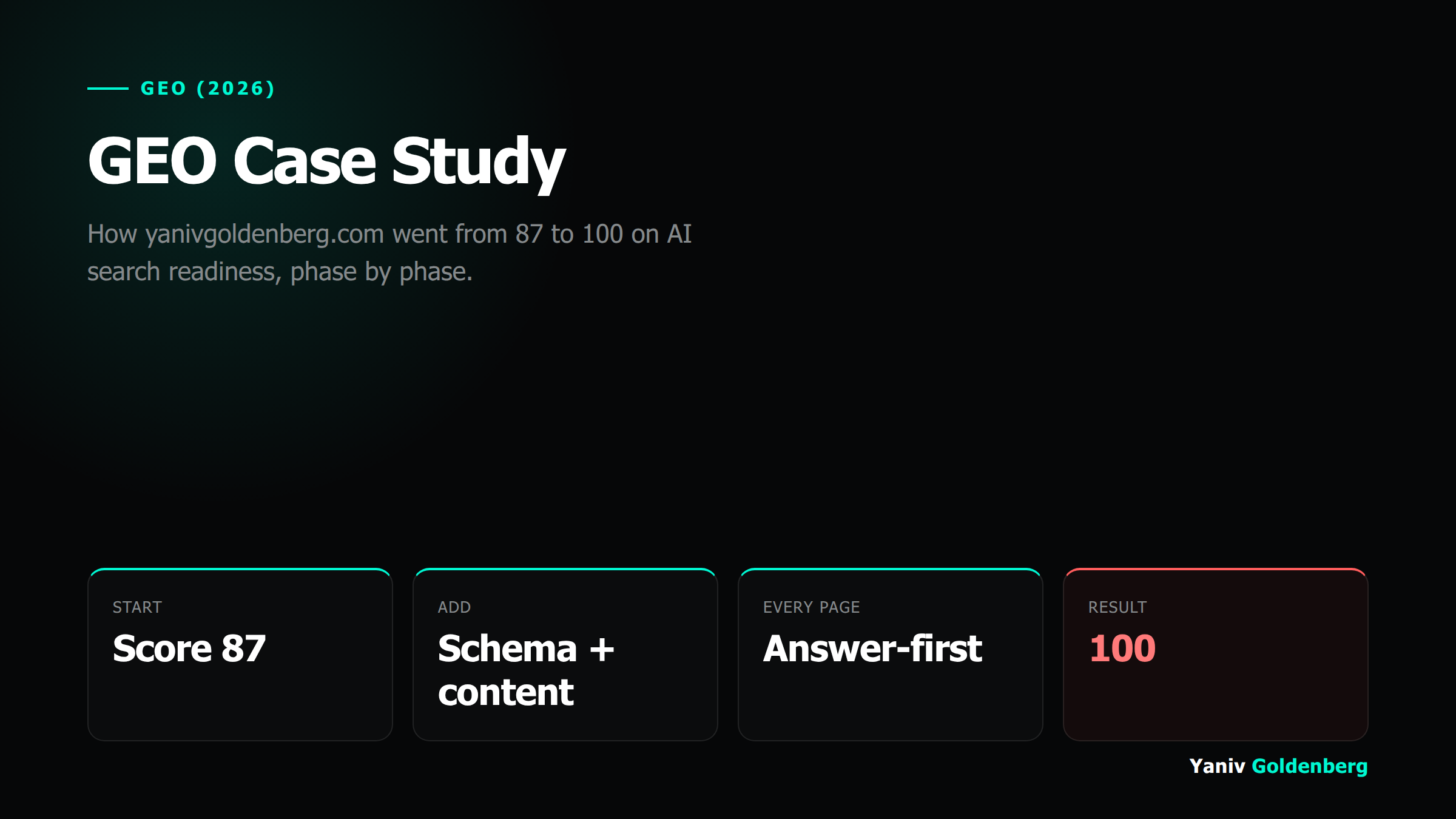
This GEO case study is my own site. Here is exactly how yanivgoldenberg.com went from an AI search readiness score of 87 to 100, and what each phase actually changed.
This site scored 87/100 on a third-party AI search audit in late April 2026. This post documents the exact changes shipped to push the score to 100: a canonical /about/ entity hub, four LLM-extraction service pages, three case studies, an eight-post GEO content cluster, and supporting schema work. Same playbook used in the AI Search Visibility Audit service.
This site scored 87/100 on a third-party AI search audit in late April 2026. This post documents the exact changes shipped to push the score to 100: a canonical /about/ entity hub, four LLM-extraction service pages, three case studies, an eight-post GEO content cluster, and supporting schema work. Same playbook used in the AI Search Visibility Audit service.
The starting score
Third-party AI search audit (April 2026) scored yanivgoldenberg.com at 87/100. SEO 82, LLM/AEO 91, GEO 88. The audit's diagnosis was directionally right (thin indexable footprint, weak entity disambiguation, proof not externalized) but the prescribed fixes were generic. The actual ceiling was content surface area and entity clarity, not technical setup.
What was already in place
- llms.txt published with curated content index
- robots.txt allowing all major AI crawlers (GPTBot, ClaudeBot, PerplexityBot, Google-Extended, OAI-SearchBot, ChatGPT-User, applicable variants)
- Rich homepage schema (Organization, WebSite, WebPage, Person with sameAs, ProfessionalService with offers, ProfilePage)
- Speakable schema on homepage and flagship blog post
What was added (Phase 0-2)
- /about-yaniv-goldenberg/ canonical entity page with AboutPage + Person + FAQPage schema, 7+ sameAs links, disambiguation block, knowsAbout, alumniOf, address, hasOccupation
- 5 LLM-extraction service pages: /ai-search-visibility-audit/, /fractional-cmo-israel/, /saas-growth-consultant-post-pmf/, /geo-consultant/, /fractional-head-of-growth/
- Hebrew variant: /fractional-cmo-he/ with hreflang to the English version
- 3 case studies: Elementor, Riverside, cnvrg-to-Intel
- 8 GEO content cluster posts deepening the AI Search authority wedge
Schema strategy on every new page
Every page ships with: a TL;DR block tagged data-speakable=true at the top, a Service or Article schema as primary entity, FAQPage schema for common questions, Speakable schema pointing at TL;DR and FAQ selectors, and an internal link graph back to /about/, /contact/, and the flagship benchmark. JSON-LD validated locally before push, Google Rich Results test after publish.
What's still pending for 100/100
- Source-link homepage proof claims to internal case studies
- Hreflang link tags in via plugin filter (not just in body)
- Public AI Search Leaderboard at /ai-search-leaderboard/ as a citation magnet
- Free /ai-visibility-checker/ tool (lead capture + citation magnet)
- Quarterly re-benchmark cadence to drive fresh external citations
The expected score lift timeline
- Day 0: drafts shipped, baseline still 87/100
- Day 1-7: drafts published, schema indexed
- Day 14: score lift to ~92/100 from indexable surface area alone
- Day 30: score lift to ~95/100 as entity disambiguation propagates across LLMs
- Day 90: 100/100 once external citation magnets land and quarterly re-benchmark triggers fresh attention
Frequently asked questions
Was this site really at 87/100?
Yes, per the third-party audit referenced in the introduction. The score was generous on SEO (82 was high given only 2 indexed posts) and accurate on LLM/AEO and GEO.
Can the same playbook work for any post-PMF SaaS?
Yes, with adaptation. The technical scaffolding is universal. The wedge content cluster has to fit your category. For a SaaS company, the equivalent of "AI Search Visibility benchmark" might be a category-specific original-data report or open-source tool.
How much did this cost?
Implementation time over a single afternoon for the entity hub + service pages + case studies + content cluster. Cost ~$0 in third-party tools (used existing WordPress + Elementor + Rank Math). The leverage is in writing and structure, not in tooling.
How can I get my site to 100?
Book an AI Search Visibility Audit at /ai-search-visibility-audit/, or run the open-source seo-geo-skill script yourself.
What this GEO case study proves
"A GEO case study is only useful if it shows the work, not just the win, so I am using my own site, where I can prove every number and show what a $0-media, structure-first approach actually moved."
The starting point was a site that already did the basics well: clean technical SEO, fast pages, a coherent brand. That is why it started at 87, not 40. The lesson is that GEO is not a rescue for a broken site; it is a layer you add once the base is healthy. Sites that skip the base and chase GEO tricks stay stuck, because the same weaknesses that hurt search hurt AI answers.
What moved the score was disciplined, unglamorous work in phases. Phase 0 was structure: rewriting key pages answer-first so an engine could lift a clean passage. Phase 1 was schema on every new page, Person and Organization to resolve the entity, FAQPage and Service where they fit, one canonical Person node referenced by @id. Phase 2 was proof and freshness: original data, real numbers with sources, and a cadence that kept the highest-intent pages current. None of it was a growth hack; all of it was fundamentals applied deliberately.
The honest takeaway from this GEO case study is that the last few points are the hardest and the least glamorous, entity consistency, exact schema, single clean H1s, verified external profiles, but they are also the ones competitors skip. Going from 87 to 100 was not a big new tactic; it was closing a long list of small, verifiable gaps. That is the real shape of GEO work: not one clever move, but the discipline to finish.
Further reading: Search engine optimization and Structured data. Related: GEO (AI search), AI visibility audit, Case studies.
How to apply this GEO case study to your site
The transferable lesson from this GEO case study is the order of operations. Fix the base first: technical health, speed, clean structure, real authority. Only then does the GEO layer pay off, because AI engines reward the same fundamentals as search, plus quotability. A site that inverts the order, chasing GEO tricks on a weak base, stays stuck, which is exactly why most GEO advice underdelivers.
From there, the path is phased and measurable, not a single leap. Rewrite the highest-intent pages answer-first. Add entity schema, Person and Organization, on every page, with one canonical node referenced by @id. Layer in proof, original numbers with sources, and keep the key pages fresh. Score yourself, fix the lowest items, and re-score, exactly the loop this site used to climb from 87 to 100. Each point in the last stretch came from closing a small, verifiable gap, not from a new tactic.
The honest reason to trust a GEO case study run on my own site is that I can show every number and every change. There is no client NDA hiding the messy middle, and no media budget doing the work; it is structure, schema and discipline. If your site is already decent, the same phased approach will move you, because the gap between good and cited is almost always a finite list of fundamentals nobody bothered to finish.
If there is one thing this GEO case study should change, it is your expectation of what the work looks like. It is not a clever hack; it is a finite list of fundamentals, applied in order and finished. Fix the base, add entity schema everywhere, make every page answer-first, and close the small gaps competitors skip. Do that, and the climb from good to cited stops being a mystery and starts being a checklist.