
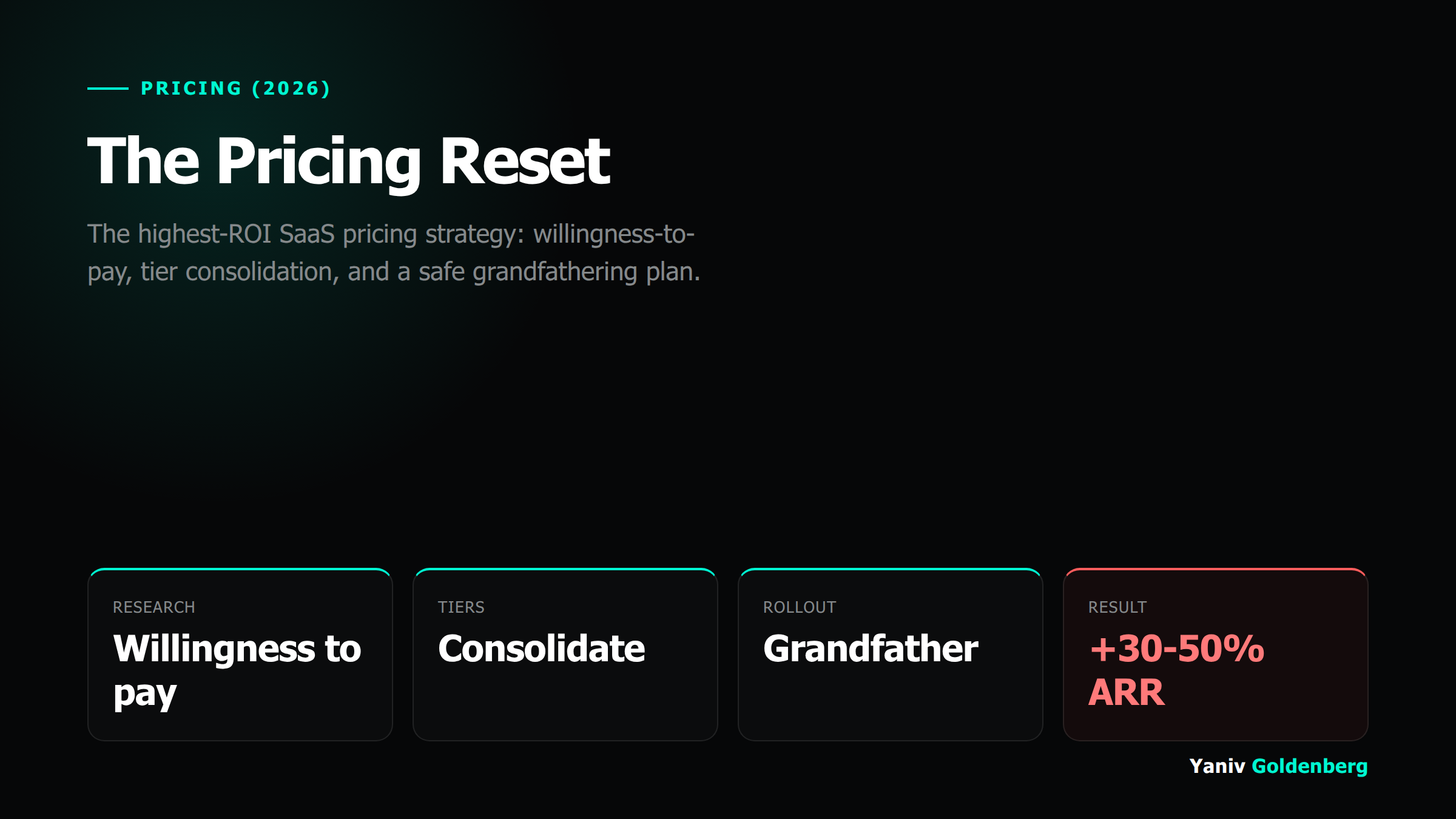
A SaaS pricing strategy is the highest-ROI growth lever you own. A disciplined SaaS pricing strategy reset can lift ARR 30-50% with zero added ad spend. Here is how.
At every SaaS company I have worked with, pricing is the one growth lever nobody wants to touch. It feels risky. It requires cross-functional alignment. It touches revenue directly. As a result, most companies set their pricing at launch, run it for 2-3 years without testing it, and leave 30-50% of potential ARR sitting on the table.
This post covers the pricing reset framework I use: the willingness-to-pay audit, the tier consolidation decision, and the grandfathering plan that keeps existing customers from churning when you raise prices. This is step 3 of the 1,000-User System.
Why Pricing Is the Highest-ROI Growth Lever
A 1% improvement in pricing produces a bigger impact on operating income than a 1% improvement in volume or a 1% reduction in variable costs. McKinsey documented this in a 2003 study. It has been replicated many times since. The mechanism: pricing improvement flows almost entirely to the bottom line, while volume improvements carry acquisition costs and variable costs with them.
But here is the version that matters for growth-stage SaaS: if your current pricing is leaving 30% of willingness-to-pay on the table (very common at Series A companies that set pricing before they understood their customer), a pricing reset can add $300K to $600K ARR per $1M of existing ARR with zero change to product and zero acquisition spend.
I am not estimating. At Elementor, a single pricing restructure in 2020 lifted ARPU by 34% and contributed directly to moving from $3M to $6M ARR in 12 months. No new product features. No increase in paid acquisition budget. Just a pricing page that matched what the market was actually willing to pay.
Step 1: The Willingness-to-Pay Audit
The willingness-to-pay (WTP) audit answers one question: what would your paying customers have paid if you had asked them to pay more?
The audit has three components:
Component A: Price Sensitivity Survey
Email your last 90 days of paying customers (minimum 50 responses needed for significance). Ask four questions using the Van Westendorp Price Sensitivity Meter:
- At what price would you consider this product too expensive to consider?
- At what price would you consider this product expensive but still worth considering?
- At what price would you consider this product a bargain?
- At what price would you consider this product too cheap to trust its quality?
Plot the four response distributions. The intersection of "too expensive" and "not cheap enough" gives you the acceptable price range. The intersection of "bargain" and "expensive but worth it" gives you the optimal price point. If your current price is below the optimal point, you have room to raise.
Component B: Cohort ARPU Analysis
Pull your ARPU by cohort month for the last 24 months. If ARPU is flat or declining despite product improvements, it is evidence that you are not capturing the value you are delivering. Growing products that do not raise prices over time are implicitly discounting relative to value.
Component C: Competitor Pricing Audit
Map your pricing against 3-5 direct competitors. If you are priced below median for equivalent features, you have pricing room. If you are priced above median but losing deals on price, the issue is value communication, not pricing itself.
| Input | What You Learn | Time Required |
|---|---|---|
| WTP Survey (50+ responses) | Optimal price point and acceptable range | 1-2 weeks to collect |
| Cohort ARPU trend | Whether you are capturing growing or shrinking value share | 1 day to pull |
| Competitor pricing map | Relative positioning and justification for price increase | 2-3 hours to research |
Step 2: The Tier Consolidation Decision
Most SaaS pricing pages have too many tiers. Three or four tiers feel comprehensive from the inside. From the outside, they create decision paralysis that kills conversion.
The research on this is consistent: when a pricing page has more than 3 options, conversion drops as customers defer the decision rather than make the wrong one. The sweet spot is 2-3 tiers with clear differentiation on a single axis (usually: usage limit, feature set, or support tier).
At Elementor in 2020, we had 4 pricing tiers. The bottom two tiers were priced $4 apart and had almost identical feature sets. Customers were spending time trying to figure out the difference and landing on "I'll come back to this later." We collapsed them into one tier, priced it between the two originals, and saw pricing page conversion improve by 22% in the first 30 days.
Receipt: The Elementor pricing page before the 2020 restructure had four tiers: Personal ($49/yr), Plus ($99/yr), Expert ($199/yr), Agency ($999/yr). After the restructure: Essential ($59/yr), Pro ($199/yr). Revenue per new signup went up 34% in the 90 days following the change. The middle two tiers had been creating a choice problem with no clear resolution. Removing the choice increased conversion and ARPU simultaneously.
Step 3: The Grandfathering Plan
The reason most companies avoid pricing resets is the fear of churning existing customers. That fear is legitimate but solvable. The grandfathering plan determines who gets what treatment when you raise prices.
The framework I use has three segments:
Segment 1: Recent customers (paying less than 6 months)
Move them to new pricing at their next renewal date. No exceptions, no special treatment. They chose your product recently at something close to the new price point. Churn risk is low.
Segment 2: Mid-tenure customers (6-24 months)
Give them 12 months at their current price, then move to new pricing with 60 days notice before the renewal. Notify them 3 months before the change with a clear explanation of what new features or improvements the higher price enables. This group is your highest-risk segment for churn because they have enough usage history to evaluate alternatives. Do not surprise them.
Segment 3: Long-tenure customers (24+ months)
Offer a permanent 20% loyalty discount on the new pricing. They never pay the full new price. This segment is your most likely to talk about you publicly (positive or negative) and your most likely to refer. The discount is worth it for retention and word-of-mouth value.
What Not to Do
Do not run a pricing A/B test without having a clear hypothesis. Most pricing A/B tests produce ambiguous results because they run for too short a time (need at least one full billing cycle), measure the wrong outcome (clicks on the plan, not actual paid conversions), or test too many variables simultaneously (price, tier structure, and copy all at once).
Change one thing at a time. Measure for at least 4 weeks before drawing a conclusion. The most common mistake: running a pricing test for 10 days, seeing a noise-level difference, and declaring the test inconclusive. Pricing decisions made on insufficient data are worse than no pricing test at all.
The Numbers You Should Expect
Based on pricing resets I have run or advised on at 6 B2B SaaS companies in the $1M-$15M ARR range:
- Median ARPU lift from tier consolidation alone: 18-28%
- Median ARPU lift from price point increase (10-25% raise): 8-15% net of churn
- Churn rate increase in the 90 days following a pricing change: 1-4 percentage points (temporary, usually reverts within 6 months)
- Net ARR impact at $3M ARR from a complete pricing reset (audit + consolidation + 20% raise): $400K-$800K incremental ARR within 12 months
These numbers assume you have done the WTP audit first and the price increase is supported by evidence, not guesswork. Raising prices without the audit is not a pricing reset. It is guessing with consequences.
Next Step
This is step 3 of the 1,000-User System. It comes after activation (steps 1-2) because raising prices into a leaky activation funnel only accelerates your payback period problem. Fix activation first. Then do the pricing reset.
Download the full playbook for the Van Westendorp survey template, the ARPU cohort analysis query, and the grandfathering communication sequence.
If you want a second opinion on your current pricing architecture: book a 30-minute call. Send me your current pricing page and I will come with a hypothesis before we talk.
SaaS pricing strategy FAQ
Why is pricing the highest-ROI SaaS pricing strategy lever?
Because a price change drops almost entirely to revenue with no added acquisition cost. A 10-20% effective price increase on the right tiers can lift ARR 30-50% without spending a shekel more on ads.
How do I run a willingness-to-pay analysis?
Interview current and churned customers, test price points against perceived value, and segment by who gets the most value. The goal is to find where price is leaving money on the table without pushing away your best-fit buyers.
How do I raise prices without losing customers?
Consolidate confusing tiers, apply new pricing to new customers first, and grandfather existing ones for a defined window. Communicate the added value, not just the number, so the increase reads as fair.
Further reading: Pricing strategies and Price elasticity of demand. Related: Growth services, Consulting, Fractional CMO.
A disciplined SaaS pricing strategy is not a one-time bump; the best SaaS pricing strategy is revisited every year as your value and segments shift.