
Platform ROAS Is Lying. Here Is the Real Number.
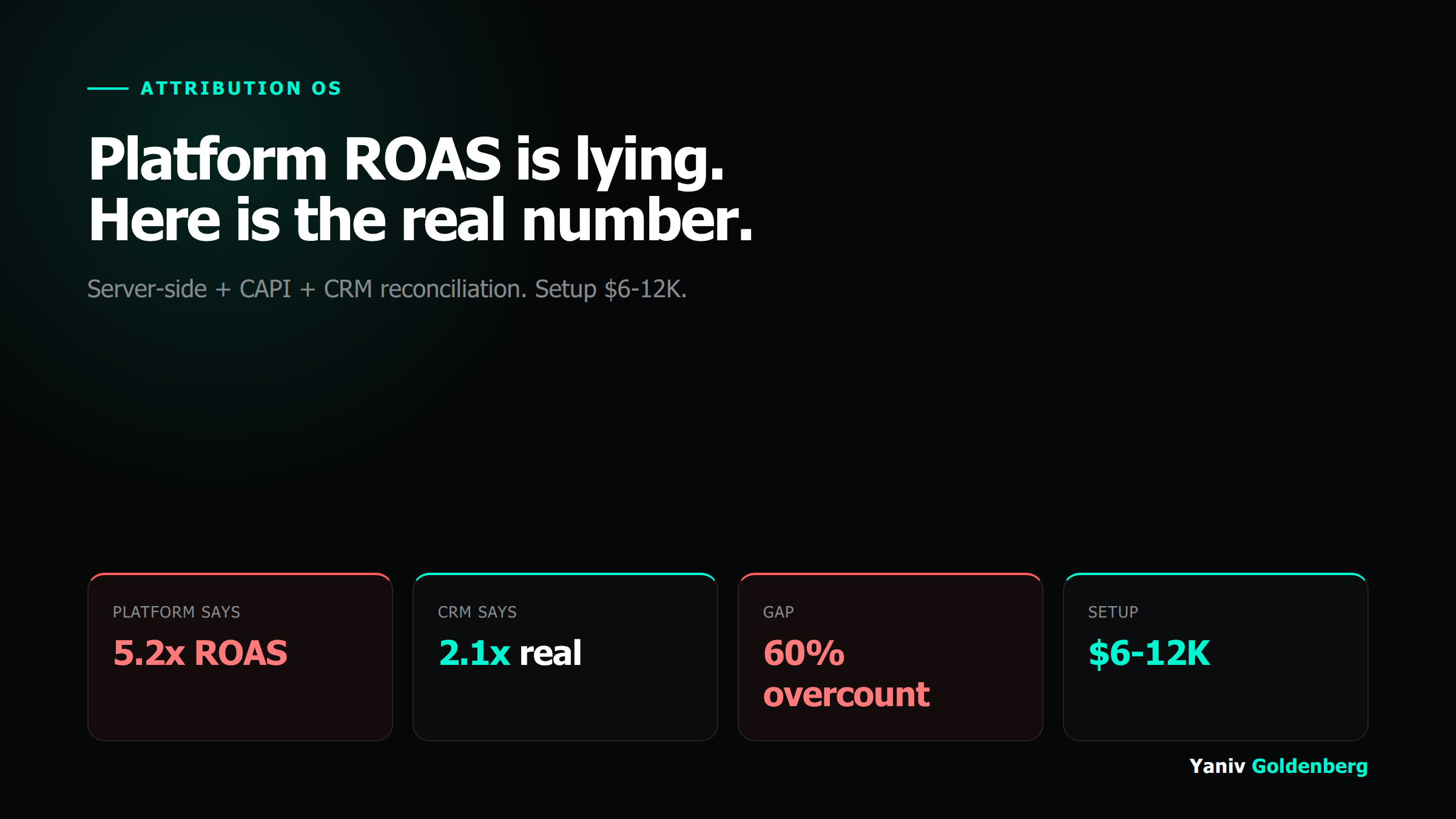
Your Meta dashboard says 5x. Your CFO asks why revenue is not moving. The gap is attribution: platform pixels miss product events and overcount conversions by 20-60% on iOS and consent-wall traffic. Attribution OS reconciles spend, product behavior, and CRM revenue into a number you can show a board. No budget approved for the next cycle until you have the real number. Setup $6-12K.
Spend, product behavior, and revenue reconciled into finance-grade CAC
Attribution OS reconciles three streams your stack currently tracks in isolation: ad spend, product behavior events, and CRM revenue. The gap between what Meta or Google reports and what your CRM closes is not a rounding error. On iOS-heavy audiences with consent walls, that gap is 20-60%. At $100K in monthly spend, it means you are scaling a channel that loses money at the real ROAS level.
The output: finance-grade CAC by channel, cohort payback from first ad touch through product activation to closed revenue, and a weekly automated report your CFO can take to a board meeting. Before you approve another dollar - or shekel - of budget, you need the reconciled number, not the platform estimate. Setup $6-12K.
How platform ROAS overcounts and why it costs you real money
Meta reports 5.2x ROAS. Your CFO asks what the real return is. You cannot answer, because the pixel fires on form submit and stops there. What happened after the form? How many product trials activated? How many became paying customers? At what price? With what cohort payback? The platform does not know because it never saw the product behavior events.
On iOS-heavy audiences, pixel attribution typically misses 20-40% of conversion events. On B2B stacks where the sales cycle is 14-90 days, the pixel fires on demo booked and calls that a conversion. Your CRM closes 18% of those demos. The platform's ROAS is based on 100%. The real ROAS is based on 18%.
At $100K/month in ad spend, a 60% ROAS overcount means you are scaling a channel that loses money at the CRM-verified level. You keep increasing budget because the dashboard says 5x. The board asks why revenue is not moving.
Platform ROAS vs CRM truth: what Attribution OS closes
Truth sprint first, then full Attribution OS setup
Attribution OS starts with a $6-8K truth sprint (one week: gap analysis, what your platform reports vs what your CRM closed, findings delivered). If the gap is material, the full setup runs $6-12K depending on stack complexity. Ongoing management retainer from $3K/month. Truth sprint credit applies to setup if you proceed. Full tier comparison at AI Growth Systems and pricing.
Who Attribution OS is built for
Right fit if:
Spending $30K+/month on paid and cannot reconcile platform ROAS with CRM revenue
CFO or board has asked why revenue growth does not match marketing spend
iOS 14+ or consent walls have broken your pixel signal
You are making budget allocation decisions from platform dashboards alone
You know your attribution is broken and want the real number before scaling more
IL ecom or B2B team where the CFO tracks ILS revenue and ad dashboards report USD, creating a reconciliation gap
Not the right fit if:
Spending under $10K/month: the attribution gap is real but smaller in absolute dollars
No CRM or closed-deal tracking: Attribution OS requires a revenue source of truth
Pre-revenue: measurement infrastructure comes after you have something to measure
Looking for a GA4 audit only: this is a full stack install, not a config review
What Attribution OS installs in your stack
Server-side event collection
Move core conversion events off the browser and onto your server. Consent walls and ad blockers cannot intercept server-side events. iOS 14 restrictions apply to browser pixels, not server calls. Signal recovery: 20-40% of events you are currently missing come back.
Meta CAPI and Google enhanced conversions
Feed verified conversion signals directly to Meta and Google from your server. Higher match quality, better optimization signal, lower CPAs as platform algorithms learn from real conversion data instead of probabilistic browser guesses.
Identity stitching
Connect anonymous sessions to known users across channels and devices. The paid click that became a form submit that became a closed deal in month two gets connected into one revenue trace. No more dark funnel.
CRM revenue reconciliation
Every week, the attribution model reads your CRM closed-won revenue and reconciles it against platform spend by channel and campaign. The output: real CAC, real ROAS, real cohort payback. Platform numbers are shown alongside CRM truth for full transparency.
Cohort payback calculation
For each acquisition cohort: how much was spent, when did they convert, what did they pay, and when did the channel pay back. Finance-trust output: payback period by channel that a CFO can use to make budget allocation decisions without guessing.
Weekly automated report
Every Monday: spend summary, platform ROAS, CRM ROAS, gap flag, cohort payback update, and anomaly alerts. Runs without manual ops. The report writes itself. Human reviews the decisions, not the data collection.
Week 1 to week 6: from ROAS lie to CRM truth
Gap analysis and architecture design
Audit existing tracking. Map all conversion events including product behavior. Run the gap analysis: platform reported vs CRM closed, by channel. Deliver findings: this is your real ROAS, this is the gap, this is what the setup phase fixes.
Server-side, CAPI, identity stitching
Install server-side event collection. Configure CAPI and enhanced conversions. Build identity stitching layer. Run parallel with existing pixel to verify event match and signal quality before cutover.
CRM connection, reports, first output
Connect CRM closed revenue. Build reconciliation model. Generate first weekly report: platform vs CRM truth side by side. Finance sign-off on methodology. Attribution OS is live.
Attribution rebuilt at scale, with verifiable results
Attribution OS vs every other approach on your table
"At Riverside.fm, the first deliverable was not a campaign. It was multi-touch attribution that kept reporting true revenue after iOS 14 broke pixel signal. Only then did spend scale to $450K a month without CAC drift."
| Approach | What you get | The real problem |
|---|---|---|
| Platform dashboards only | Platform ROAS: 5x | Real ROAS: 2x. CFO cannot reconcile. |
| GA4 audit | Better GA4 config | GA4 fires on session, not CRM close |
| UTM tracking only | Channel traffic attribution | No revenue tie, no cohort payback |
| MMP (AppsFlyer, Adjust) | Mobile attribution | B2B SaaS and web funnels require CRM reconciliation |
| Attribution OS | Server-side + CAPI + product events + CRM truth | None: built for this exact stack and problem |
Attribution OS FAQ
On server-side tracking and CAPI implementation: Meta Conversions API setup guide and Google Tag Manager server-side documentation.
How much does platform ROAS actually diverge from real revenue?
The gap varies by stack and consent rate. On iOS-heavy audiences, pixel attribution typically misses 20-40% of conversion events before any CAPI fix. After CAPI and server-side events, the platform reports match CRM closed revenue to within 10-15% on most B2B stacks. Consumer apps with strong consent walls can see wider initial gaps. The Attribution OS truth sprint surfaces your specific gap before the setup investment.
What is the difference between a GA4 audit and Attribution OS?
A GA4 audit reviews your existing GA4 configuration. Attribution OS installs the full measurement stack from scratch: server-side collection, CAPI for Meta and Google, identity stitching from anonymous to known user, product events mapped to revenue events, and a reconciliation layer that ties ad spend to CRM closed deals. GA4 is one node. Attribution OS is the whole nervous system.
How long does the truth sprint take?
One week. Day 1-2: audit existing tracking, map all conversion events, identify gaps. Day 3-4: document the attribution architecture needed, estimate the spend exposure. Day 5: findings delivered: what ROAS is currently based on, what the real number is, and what the setup phase fixes. Truth sprint $6-8K. Setup credit applies if you proceed.
What makes the Attribution OS output finance-trustworthy?
Four criteria: (1) revenue events come from CRM closed data, not platform conversions. (2) Cohort payback is calculated from first touch to CRM close, not platform-reported ROAS. (3) Every channel's CAC uses the same denominator: booked revenue, not leads or MQLs. (4) The weekly report runs automatically and flags discrepancies without human interpretation. A CFO can take this to a board meeting and defend every number.
Does this work for e-commerce or only B2B SaaS?
Both. The event taxonomy differs: e-commerce maps product view, add-to-cart, purchase, and LTV cohorts. B2B SaaS maps demo booked, trial started, paid conversion, and expansion. The server-side infrastructure, CAPI layer, and reconciliation method are identical. The cohort payback window is shorter for e-commerce and longer for SaaS. Both outputs are finance-trustworthy by the same four criteria.
Related: marketing attribution consultant, GA4 audit, AI Growth Systems
Related: AI Growth Systems hub covers the full product catalog. Marketing attribution consultant overview. GA4 audit for existing GA4 configuration review. Free benchmark: AI Visibility Audit shows your current AI growth infrastructure and measurement gaps.
One-week truth sprint: find the real ROAS gap in your stack
Bring your current platform ROAS and your last 90-day CRM closed revenue. I will find the gap, document what Attribution OS fixes, and deliver the findings in a week. If the numbers match, you do not need the full setup. If they do not, you do.