
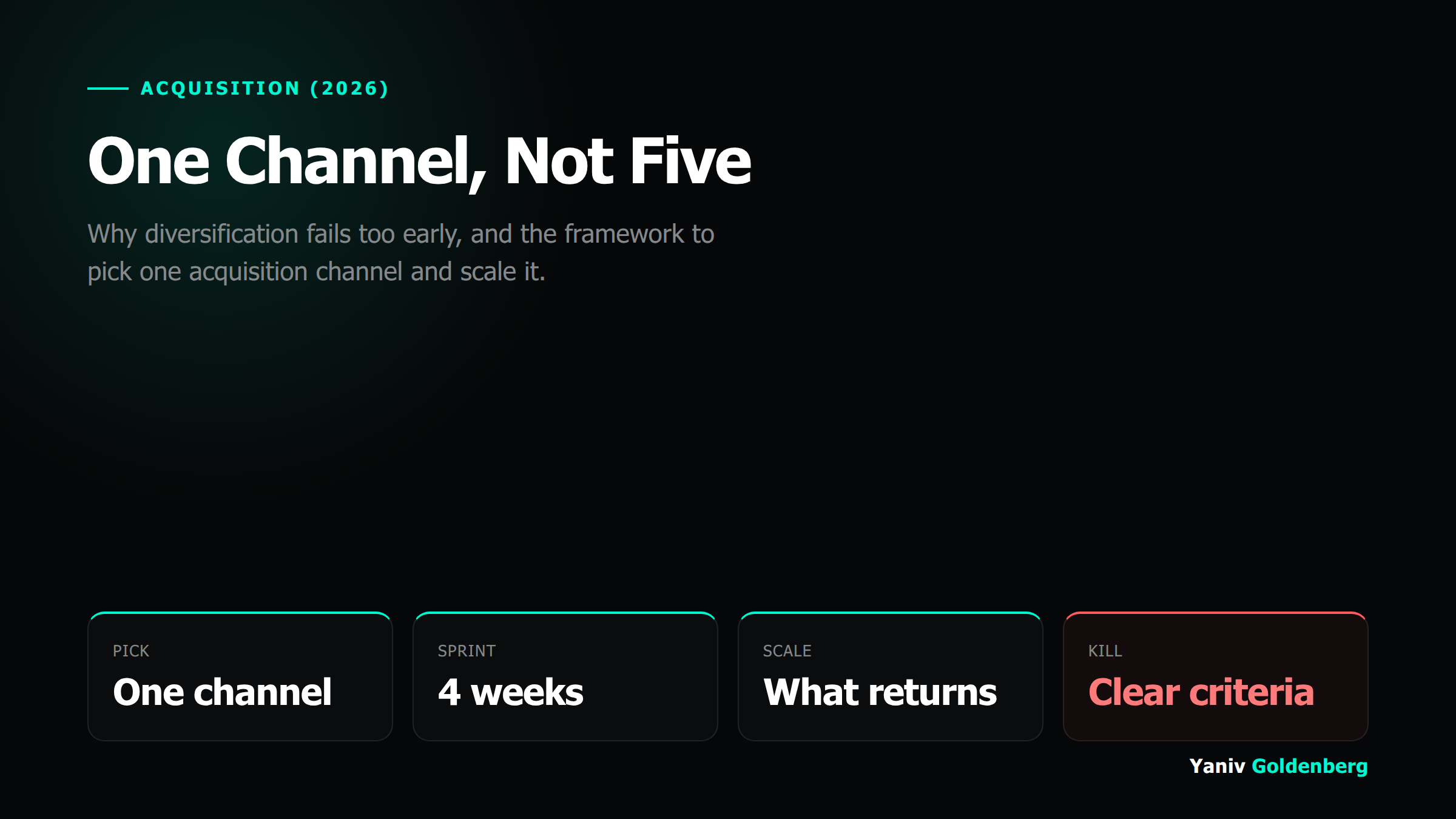
The right acquisition channel is the one your buyer already uses and you can execute. Pick one acquisition channel, scale it, and stop splitting effort across five.
The most common acquisition mistake I see at Series A SaaS companies: five channels, all of them understaffed, none of them profitable. The team is "diversified." The CAC is terrible across the board. Nobody can tell you which channel actually works because none of them have been run at full effort long enough to find out.
This post makes the case for doing the opposite: pick one channel, run a focused 4-week sprint, get to a clear answer, then decide. This is step 4 of the 1,000-User System.
Why Diversification Fails at This Stage
Diversification is the right strategy for a mature acquisition engine. It is the wrong strategy for building one. The difference: a mature engine has proven unit economics on at least two channels. Building one means you have nothing proven yet.
When you spread effort across 5 channels with a small team, you get systematic underperformance on all of them. Paid search needs 4-6 weeks of bid optimization before the algorithm stabilizes. Content needs 12-16 weeks of compounding before it generates meaningful traffic. Partnerships need relationship time before they produce pipeline. None of these work at 20% effort with no dedicated owner.
The math is brutal: 5 channels at 20% effort each gives you 5 half-measured experiments, none of which reach the sample size needed to make a decision. One channel at 100% effort for 4 weeks gives you one answer you can actually trust.
The Channel Selection Framework
Before the sprint, you need to pick the right channel to test first. The right channel is not the one you personally like or the one your investor mentioned at the last board meeting. It is the one most likely to produce the highest volume of qualified paying users at a sustainable CAC given your current resources.
Score each candidate channel on 4 dimensions:
| Dimension | What to Measure | Weight |
|---|---|---|
| Audience match | Can you reach your exact ICP through this channel? | 30% |
| Speed to signal | How many weeks before you know if it is working? | 25% |
| Cost to test | Budget and time required to run a credible test | 25% |
| Scalability ceiling | If it works, can you 10x it without hitting a wall? | 20% |
Score each channel 1-5 on each dimension. Multiply by the weight. The highest-scoring channel gets the sprint. The rest get deprioritized. Not killed: deprioritized. If the sprint channel fails, you move to the second-ranked channel.
The 4-Week Sprint Structure
Week 1 is setup: tracking in place, creative or copy ready, landing pages live, baseline numbers documented. Do not run traffic before week 1 setup is complete. Untracked spend is wasted spend.
Week 2 is launch: start the channel at minimum viable budget or effort. The goal is not to generate results. The goal is to identify what is broken before you spend real money.
Week 3 is optimization: fix the obvious failures from week 2. Adjust targeting, creative, copy, or landing page. Run the clean version for at least 5 full days before drawing any conclusions.
Week 4 is measurement: pull the full data set. Calculate CAC, conversion rate at each funnel step, and payback period. Make the call: scale, iterate further, or kill.
The Elementor Google Ads Sprint: What It Actually Looked Like
In Q2 2020 at Elementor, we had been running Google Ads as one of four acquisition channels, managed part-time by a generalist marketer with a $15K/month budget shared across all channels. Results were mediocre: CAC of $210, 3.2% conversion from click to trial, 18% trial-to-paid conversion.
We ran the channel selection framework and Google non-brand search scored highest: strong audience match (people searching "WordPress page builder" or "Elementor alternative" are explicitly in-market), fast signal (paid search shows results within days, not weeks), manageable test cost (we could run a credible test on $20K), and clear scalability (Google's auction scales with budget).
We pulled all budget from the other channels for 4 weeks and put a dedicated person on paid search full-time.
Receipt: Week 1 setup - we rebuilt the account structure from scratch, moved from broad match to exact and phrase match only, created 12 ad variants across 3 value propositions, and built dedicated landing pages for each campaign theme. Week 2-3 we ran $22K in spend and identified that "drag and drop website builder" as a search term was converting at 2x the rate of "Elementor" branded terms despite having 40% lower CPCs. Week 4 result: CAC of $142 (down from $210), trial-to-paid conversion 24% (up from 18%), and a clear winner creative theme. We scaled the budget to $80K/month over the following quarter. By Q4 2022, paid search was generating 40% of net new paying users at a CAC of $94.
That result did not happen because we got lucky on a channel. It happened because we ran the sprint properly: one channel, full effort, proper tracking, 4-week time box, clean decision at the end.
The Kill Criteria
Equally important as the decision to scale is the decision to kill. A channel sprint produces a kill signal if any of these are true after week 4:
- CAC exceeds 18-month LTV at current conversion rates with no clear optimization path
- The audience you are reaching does not match your ICP (high CTR, low trial-to-paid conversion)
- The channel cannot scale beyond 3x current volume without structural changes
- The required effort per dollar of CAC is not sustainable with your team size
If you hit any kill signal, move to the second-ranked channel on your scoring matrix. Do not extend the sprint. Do not "give it one more week." The 4-week time box exists precisely to prevent the sunk-cost trap of keeping underperforming channels alive because you have already spent money on them.
What About Content? What About SEO?
Content and SEO are not sprint channels. They are compounding channels that require 12-16 weeks before they produce measurable acquisition results. Running a 4-week sprint on SEO will tell you nothing except that SEO is slow.
If content or SEO is in your channel mix, run it as a parallel long-term investment, not as a sprint candidate. The sprint methodology applies to channels that can produce a signal within 4 weeks: paid search, paid social, outbound, partnerships with measurable referrals, or community programs with trackable conversion.
The Most Common Objection
"But what if the one channel we picked doesn't work? We've wasted a month."
You have not wasted a month. You have bought a definitive answer on one channel in 4 weeks, which is faster than the 6-12 months most teams spend getting a vague non-answer across 5 channels simultaneously. A clean "no" on channel 1 saves you from spending the next year optimizing something that will never reach positive unit economics at your scale.
The goal is not to avoid wrong answers. The goal is to get to right answers faster than your competition. The sprint forces speed.
Next Step
This is step 4 of the 1,000-User System. Steps 1-3 (activation audit, instrumentation, pricing architecture) must be green before you pour budget into acquisition. If your activation rate is below 40%, every dollar you spend on acquisition is filling a leaky bucket.
Download the full playbook for the channel scoring matrix template, the 4-week sprint calendar, and the kill/scale decision tree.
If you want to talk through which channel to sprint first at your company: book a 30-minute diagnostic call. Bring your current channel mix and CAC by channel. I will tell you what I would do first.
Acquisition channel FAQ
How do I choose the right acquisition channel?
Score channels on where your buyer already is, your ability to execute, payback speed, and headroom. Pick the one channel that scores highest and give it enough budget to cross the learning threshold before judging it.
Why does running many acquisition channels fail?
Because each channel needs a minimum spend and attention to reach the point where it returns. Split across five, none crosses that threshold, so all of them look like they do not work when the real problem is dilution.
When should I add a second acquisition channel?
Only after the first is profitable and predictable. A working channel is the base you build the second on, so you add diversification as insurance, not as a substitute for focus.
Further reading: Marketing channel and Customer acquisition cost. Related: Paid media, Demand generation, Fractional CMO.