
Be Cited in AI Search. Build Real Citation Share.
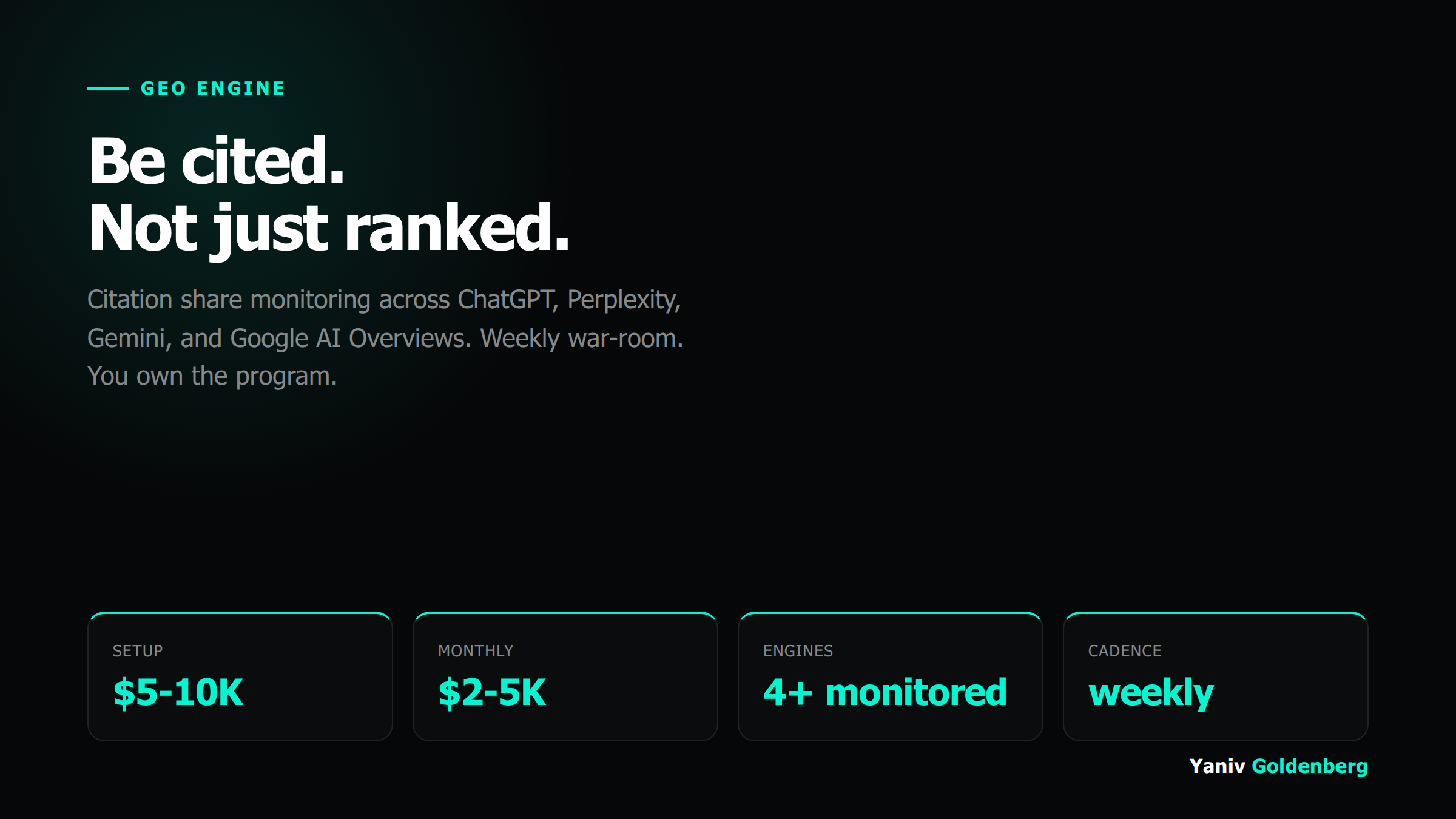
ChatGPT, Perplexity, Gemini, and Google AI Overviews decide which brands get quoted in the answer your buyer sees. The GEO Engine monitors your citation share, fixes the gaps, and runs a weekly war-room to move the number. Setup $5-10K. Retainer $2-5K/month.
Who the GEO Engine is built for and who should start elsewhere
Right fit for GEO Engine:
B2B companies whose buyers use ChatGPT or Perplexity to research vendors
SaaS or professional services with no brand presence in AI-generated answers
Teams who ran the free AI Visibility Audit and scored below 70 out of 100
Companies where a competitor is consistently cited and they are not
Content-led businesses that need AI citation, not just search rankings
Not the right fit if:
You have under 20 pages of content; build content volume before monitoring citations
You have no structured data on your site; start with a GEO Audit first
You expect citation share to move in 2 weeks; this is a 90-day+ program
Your site is not indexed by Google; AI Overviews pull from indexed content
You need campaign execution alongside GEO; pair with AI Foundation instead
Citation share is the KPI. Here is how it gets measured and moved.
GEO (Generative Engine Optimization) is the practice of making your content citable by AI search engines: ChatGPT with web search, Perplexity, Google Gemini, and Google AI Overviews. Citation share is the metric: how often your brand or claims appear in the AI-generated answers buyers see when researching your category.
The GEO Engine is a productized program. Setup installs the citation monitoring framework, structured data layer, and citability signals across your key pages. The monthly retainer runs the weekly war-room, tracks citation share across monitored engines, and ships the content and schema changes that move the number. Setup is $5-10K. The retainer is $2-5K/month.
This is not SEO renamed. Classic SEO optimizes for ranked results. GEO optimizes for what the AI engine chooses to quote directly. The signals overlap but the tactics differ: quotable definitions, statistic density, source attribution, and structured data matter more than keyword density in the GEO layer.
Setup $5-10K once. Retainer $2-5K per month. Start free.
What the GEO Engine builds and runs
Citation baseline and query mapping
Define the 20-50 queries your buyers use when researching your category in AI engines. Run each against ChatGPT, Perplexity, Gemini, and Google AI Overviews. Record baseline citation share by engine and by query cluster. This is the number everything is benchmarked against.
Structured data and schema installation
Audit and install JSON-LD structured data: Organization, Person, Service, FAQPage, and HowTo schemas where applicable. Each schema is validated and tested against Google's Rich Results Test and monitored in Search Console. Structured data is one of the strongest signals for AI Overviews citation.
Citability optimization of key pages
Identify 10-20 high-value pages. Add or improve: 2-3 sentence quotable definitions at the top of each page, statistic density (verified numbers AI engines can cite), source attribution for external claims, and author signals. These changes are documented and tracked for citation lift.
Multi-engine citation monitoring
Weekly citation share tracking across 4+ engines. Spreadsheet or dashboard showing citation rate by engine, by query cluster, and by page. Historical trend so you can see what moved after each change. Competitor citation tracking for the same query set.
Weekly war-room
30 minutes weekly. Agenda is fixed: citation share update, what moved and what did not, the three changes running this week, competitor snapshot. Output is an action list with a single owner per item. The war-room is a decision meeting, not a status report.
llms.txt and AI crawler access
Install and maintain the llms.txt file that tells AI crawlers what your site covers. Verify AI crawler access (GPTBot, ClaudeBot, PerplexityBot, Google-Extended). Block or permit based on your content strategy. This is infrastructure that most sites skip and then wonder why they are not cited.
The citation and GEO track record that backs this program
Citation share monitoring and a weekly war-room to move the number
Month 1 to Month 3: from baseline to a running citation share program
Baseline, setup, and first optimizations
Run citation baseline across monitored engines. Install structured data and llms.txt. Optimize the 5 highest-value pages for citability. Establish the weekly war-room cadence. First citation share report at end of month.
Content citability layer and competitor mapping
Expand citability optimization to 10-20 pages. Add quotable definitions, statistics, and source attribution where missing. Run competitor citation analysis: which pages do they win and why. Identify 3 content gaps where a new piece would win citations.
Compound and track
Weekly war-room running. Citation share tracking shows movement or flags gaps. Monthly schema and content updates based on what the monitoring shows. Retainer continues at $2-5K/month as long as the program is running.
GEO Engine versus a standard SEO retainer
| Dimension | Standard SEO agency | GEO Engine |
|---|---|---|
| What they optimize | Search rankings | Citation share in AI engines |
| KPI they report | Organic traffic, keyword positions | Citation rate by engine and query |
| Structured data | Rarely touched | Core install and maintained monthly |
| AI engine monitoring | Not in scope | Weekly across 4+ engines |
| War-room cadence | Monthly check-in | Weekly decision call |
| Quotable definitions | Not a concept | Installed on every key page |
| Citation vs ranking gap | Not measured | Tracked weekly |
Where the GEO Engine fits in the AI Growth Systems catalog
Start with the free AI Visibility Audit to get your baseline citation score before booking the GEO Engine. AI Growth Systems hub is the parent catalog. AI Foundation installs GEO as one of six systems in a 6-month engagement. Full pricing index has every product and price in one place. Sibling systems: Growth Command Center monitors spend and CAC; Content Compounder builds the content that earns citations. Note: sibling draft links resolve on drip-publish.
GEO Engine FAQ
Ranking on page one is not the same as being cited by the AI that summarizes page one for the buyer. The GEO Engine is the difference between visibility and citation.
On AI citation signals: Princeton GEO paper (arXiv:2311.09735, KDD 2024) shows statistics, quotations, and source attribution lift AI citation rates. On Google AI Overviews eligibility: Google AI Overviews documentation.
What is citation share and how do you measure it?
Citation share is the percentage of times your brand, product, or key claims appear in AI-generated answers for the queries that matter to your business. Measurement works by running a defined set of representative queries against ChatGPT, Perplexity, Gemini, and Google AI Overviews weekly, recording whether your brand is cited, and tracking the share over time. The baseline comes from the audit. The weekly war-room reviews what changed and why.
Which AI engines does the GEO Engine monitor?
The core set: ChatGPT (including web search), Perplexity AI, Google Gemini, and Google AI Overviews. LinkedIn AI summaries and Bing Copilot can be added based on where your buyers actually spend time. The monitored engine list is agreed at setup and reviewed quarterly as the landscape changes.
What is the weekly war-room?
A structured 30-minute session each week: citation share by engine, what moved and what did not, the three content or schema changes that will run next week, and a competitor citation snapshot. The output is an action list with a single owner for each item. Not a status call. A decision call.
How does this connect to the free AI Visibility Audit?
The free AI Visibility Audit at yanivgoldenberg.com/ai-visibility-audit gives you a 7-point citation score and a snapshot of where AI engines cite you today. The GEO Engine takes that baseline and builds a program to move the number: structured data, citability-optimized content, schema, and weekly monitoring. Most clients run the free audit first, then book the GEO Engine setup.
Does GEO replace SEO?
No. GEO and SEO share the same underlying content and authority signals. A page that ranks in Google also tends to get cited in AI Overviews. The GEO Engine adds the citation monitoring layer and the specific citability signals (structured data, quotable definitions, statistic density, source attribution) that lift AI citation rates independent of classic SEO rank.
What does the $2-5K/month retainer cover?
Weekly war-room session, citation share tracking across all monitored engines, monthly schema and structured data updates, one citability-optimized content piece per month, and competitor citation monitoring. The higher end of the range covers additional content volume and more engine coverage.
Run the free AI Visibility Audit, then book a GEO Engine call
The audit gives you a 7-point citation baseline in minutes. Bring that score to the GEO Engine call and I will map what the retainer looks like for your specific stack.