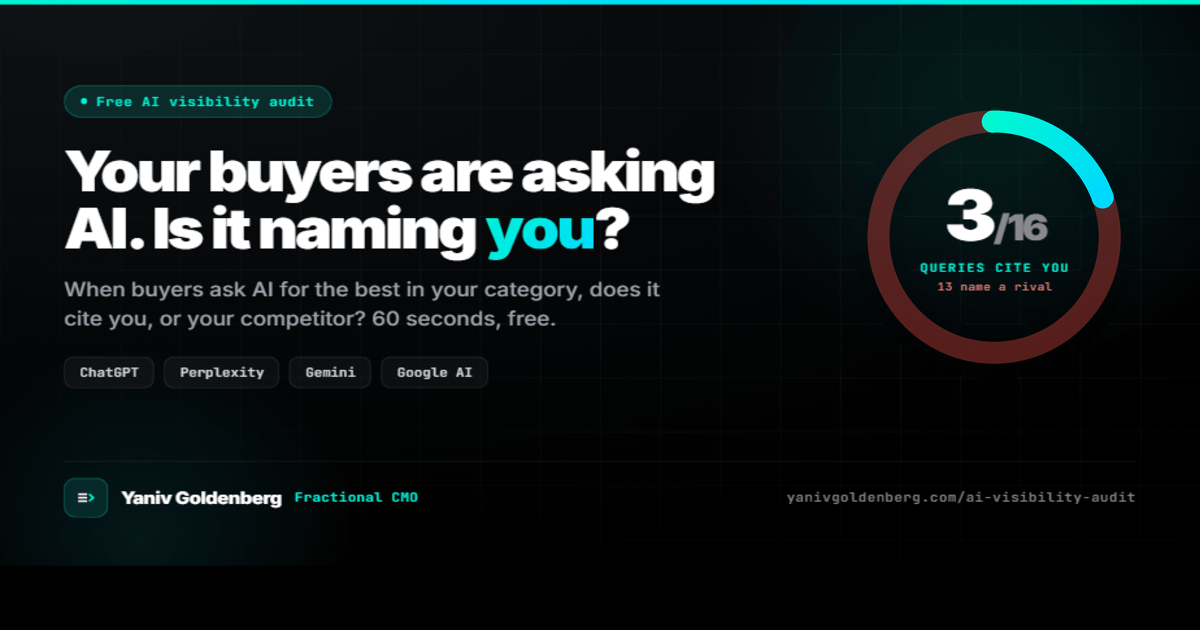
Your buyers are asking AI. Is it naming you, or your competitor?
See if ChatGPT, Perplexity, Gemini and Google AI Overviews name you when buyers ask, and get their exact answers word for word plus the page-by-page fixes. Free, 60 seconds.
•Every day you’re invisible to AI, a competitor gets named instead.
1 open slot next month
Built by Yaniv Goldenberg, ex-Elementor ($200K to $20M ARR). Prefer to talk? Book a 15-min call.
Free · 60 seconds · no signup wall
Run your free AI visibility audit
- ✓Your AI citation score across 16 buyer-intent queries
- ✓The competitors AI names instead of you
- ✓The exact sentences AI writes about your brand, word for word
✓I ran it on my own site first, cited 0 of 16. Then I fixed it.
16 buyer-intent queries, run 3 times each across the live AI engines. Domain and email only, no spam, ever.
technical checks behind the score
to your AI visibility score
buyer queries where AI cites most B2B sites
runs per prompt, so the score holds up
TL;DR
An AI visibility audit checks whether ChatGPT, Perplexity, Gemini and Google AI Overviews name you when buyers ask for the best in your category. It runs 16 buyer-intent prompts three times each across the live AI engines, then reports your AI citation score, who AI names instead of you, and the exact sentences it writes about your brand. Free, 60 seconds, with the fixes.
AI answers are the new front page
When a buyer asks ChatGPT or Perplexity for the best in your category, do you show up? Most B2B sites are invisible to AI search and never know it. AI returns one answer with a few named sources, and if your name is not in it, the buyer never reaches your site. This audit shows you exactly where you stand, in the AI’s own words.
The research behind this is public: Princeton’s GEO study measured what makes content citable by AI engines, and Google documents how AI features select sources. The audit applies both to your pages.
If AI does not cite you, your buyer never learns you exist.
You can rank #1 on Google and still be invisible to AI
Classic search ranks you in a list of ten blue links. AI search returns one answer with a few named sources. Different game, different rules, scored a different way.
-
Result format
A list of ten blue links
-
Your spot
A rank somewhere in the list
-
How buyers act
Scan, click, compare options
-
What it rewards
Keywords and backlinks
-
If you are missing
Page two, still findable
-
Result format
One answer, a few named sources
-
Your spot
Named in the answer, or not there
-
How buyers act
Ask once, trust the names returned
-
What it rewards
Citability, schema, entity clarity
-
If you are missing
Not named, never seen
What we check to score your AI visibility
These are the technical checks behind your AI visibility score. Open any one to see what it means. Tick the checks your site is missing to preview where your visibility breaks before you run the full audit.
checks missing
Nothing flagged yet. Tick the checks your site is missing.
01AI crawler accessCan the AI engines even read your site?+
GPTBot, PerplexityBot and Google-Extended have to fetch and render your pages before AI can cite you. Blocked user agents and JavaScript-only content quietly remove you from the running. The fix is boring and fast: open the right crawlers and serve your content as real HTML.
02AI citabilityAI answers are the new front page. Are you on it?+
When a buyer asks an AI engine for the best in your category, it returns one answer with a few named sources. You are either in that answer or you are not. The audit runs 16 real buyer-intent prompts, three times each across Perplexity and Gemini, and reports your citation score, the competitors AI names instead of you, and the exact sentences it writes about your brand. Then it hands you a page-by-page list of what to change so AI starts citing you.
This is the gap most teams have never measured. See the deeper play on the generative engine optimization (GEO) services page.
03Structured data and schemaCan AI parse what your page is about?+
Schema markup tells the engines what your page is, who you are, and what you sell in a format they can quote. Missing or broken structured data leaves AI guessing, and guessing engines reach for a competitor with cleaner markup. The fix adds the Organization, Service and FAQ schema the engines read first.
04llms.txt and AI policyHave you told the AI engines how to use you?+
An llms.txt file is the emerging standard for telling AI engines which content to read and cite. No file means the engines crawl blind and cite whoever made it easy. The fix publishes a clean llms.txt that points the engines at your best, most quotable pages.
05Entity clarityDoes AI know who you are?+
AI only names brands it actually understands. If your brand, your founder and your category are not stated consistently across your site and the wider web, the engines cannot connect the dots and default to a name they already trust. The fix makes your entity unmistakable, on-site and off.
06Tracking layerCan you see which pages AI sends buyers to?+
When AI starts sending buyers, you need to see it. Broken UTMs and gaps between your analytics and CRM hide which pages and answers actually convert. The fix audits the tags and parameters so every AI-driven visit ties back to a real outcome. Start with the free UTM Guardian builder and checker.
07Page metadataDo your titles and descriptions earn the citation?+
Titles, descriptions and headings are the snippets AI lifts when it quotes you. Vague or templated metadata gives the engines nothing worth citing. The fix writes answer-first titles and descriptions that read like the sentence you want AI to repeat.
My own site
I ran it on my own site, cited in 0 of 16. The result stung, then I fixed it. That is the difference between a tool and an operator: I do not hand you a score, I fix what the audit finds.
From invisible to cited in four steps
Drop your domain
No signup. We read your live site the way an AI crawler does.
We query the AI engines
16 real buyer-intent prompts, run 3 times each across Perplexity and Gemini for a number you can trust, not one lucky shot.
See where you stand
Your citation score, the competitors AI names instead of you, and the exact sentences it writes about your brand.
Get the fixes
A page-by-page list of what to change so AI starts citing you. I can push them live.
What lands in your inbox
A sample of the report. Yours runs on your real domain, with your real numbers and the real names AI returns.
ai-visibility-report.pdf
Example output
AI visibility score
Buyer queries where AI cited this sample site. The rest went to a competitor.
AI named instead of you
The brands AI recommended in your place, ranked by how often they showed up.
Perplexity, word for word
“For the best platform in this category, leading options include Rival Co., Northstar and Acme Labs.”
Sample for illustration only. Real reports use your live site and the actual names AI returns, not these placeholders.
See your AI visibility free, or have me fix it
Self-serve
The free audit
You get the score and the fix list. Run it yourself, hand it to your team, ship the changes on your own clock.
- ✓AI citation score across 16 buyer queries
- ✓Page-by-page fix list by email
- ✓No card, no sales call required
Done with you
The fix sprint
I take the audit and fix what it finds. A fixed-scope diagnostic and build sprint with named deliverables, run by the operator who scaled Elementor from $200K to $20M ARR.
- ✓Prioritized fixes shipped, not just listed
- ✓AI citability, structured data and entity clarity rebuilt
- ✓One number owned full-funnel
1 open slot next month
What people ask before running it
What is an AI visibility audit?
It checks whether ChatGPT, Perplexity, Gemini and Google AI Overviews name you when buyers ask for the best in your category. It runs 16 buyer-intent prompts three times each, then returns your AI citation score, who AI names instead of you, and a page-by-page fix list, in 60 seconds and free.
What is AI visibility?
Whether ChatGPT, Perplexity, Gemini and Google AI Overviews name you when buyers ask them for the best option in your category. It is becoming the new top of funnel, and most sites are invisible to it.
How is this different from SEO?
Classic SEO ranks you in a list of ten blue links. AI search returns one answer with a few named sources. You are either in that answer or you are not. This measures the second thing: whether AI names you, and the technical checks behind it.
Why run each query three times?
AI answers vary run to run. A single shot is noise. Three runs per prompt gives you a confidence band, not a coin flip, so you can act on the number.
Is it really free?
Yes. Drop your domain and you get the audit. No card, no sales call required. If you want the fixes pushed live, that is where I come in.
Pass it on
Know a team that is invisible to AI?
Send them the audit. 60 seconds to find out if AI is naming a competitor in their place.
Make AI cite you faster
Free marketing tools by Yaniv Goldenberg
The full set of free calculators and checkers I use to find and fix what costs you pipeline.
UTM Guardian: free UTM builder and checker
Build clean UTMs and catch the broken ones, so you can see which pages AI sends buyers to.
GEO services for AI search visibility
The done-with-you program that makes ChatGPT, Perplexity and Gemini cite you instead of your competitor.
See if AI recommends you
60 seconds, your real numbers, the exact answers AI gives about you. Then book a call and I will tell you what to fix first.
Related: geo – primary page for this topic cluster.
Google vs AI search surfaces in 2026
Buyers researching AI search market share need a practical map: classic Google results still dominate commercial navigation, while AI answer surfaces intercept research and shortlist stages. Exact global share percentages change by vendor and month; what matters operationally is whether your brand is citable on the surfaces your buyers use.
| Surface | Buyer job | What to optimize |
|---|---|---|
| Google classic SERP | Compare, navigate, transact | Intent pages, technical SEO, internal links |
| AI Overviews / AI experiences | Summarize and shortlist | Entity clarity, schema, quotable facts |
| ChatGPT / Perplexity style answers | Recommend and explain | Citability, proof, consistent brand entity |
Run the readiness checks on this page, then operationalize with GEO consulting when AI visibility is a revenue channel, not a side project.
Explore the Free Marketing Tools hub