
Content That Earns Citations. Not Traffic Theater.
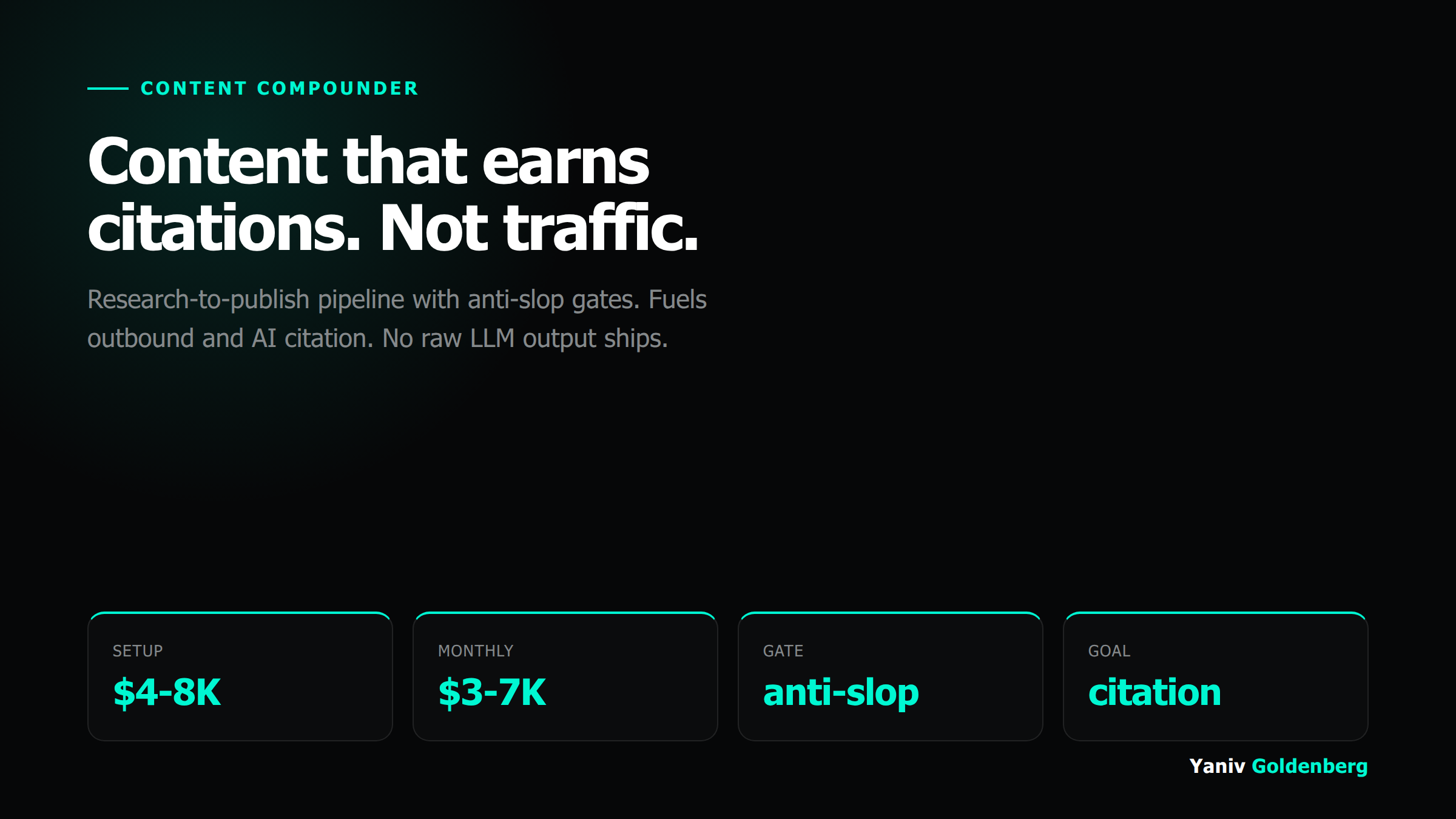
A research-to-publish pipeline with anti-slop gates, SEO and GEO optimization, and editorial review baked in. Content that fuels outbound sequences and gets quoted by AI engines. Not traffic theater. Setup $4-8K. Retainer $3-7K/month.
Setup $4-8K once. Retainer $3-7K per month.
A documented pipeline from research to publish with a gate at every stage
The Content Compounder is a documented research-to-publish pipeline. It runs from topic selection through research, brief, LLM draft, anti-slop gate, SEO and GEO optimization, editorial review, and publish. No raw LLM output ships at any stage. Every piece has an internal owner who approved it before it goes live.
The goal is content that fuels two things: outbound sequences and AI citation. Not blog posts written for keyword density that nobody reads. Not AI-generated filler that trains buyers to ignore your content. Pieces that a prospect would forward to their CEO, and that ChatGPT would quote when someone asks about your category.
Setup installs the pipeline and trains the person who will run it. The retainer runs the pipeline at volume: $3-7K/month depending on how many pieces go through each month. The pipeline is yours at the end of setup. The retainer covers iteration and maintenance.
Who the Content Compounder is built for and who should start elsewhere
Right fit for Content Compounder:
B2B teams where sales reps ask 'do we have a piece on X' and the answer is no
Companies losing AI citation to competitors who have more citable content
Marketing teams running outbound sequences with no content to back the talk tracks
Teams that tried AI writing tools and got generic output their editor had to rewrite
Content-led B2B businesses that need a repeatable system, not an agency brief
Not the right fit if:
You have no positioning clarity; content amplifies positioning, it does not fix it
You need consumer-facing creative content: this pipeline is B2B editorial
You want zero editorial involvement; a human reviews every piece before publish
You need 20+ pieces per month; the pipeline is for quality, not volume farming
You are pre-PMF; build a working product story before building content volume
What the Content Compounder installs
Topic research system
A documented process for finding the topics your buyers are asking AI engines the week before they book a call. Sources: your sales sequences, your GEO citation gaps, and your competitor citation wins. Output is a ranked content calendar tied to outbound and citation goals, not to keyword volume estimates.
Brief template and generation
A structured brief format: the audience, the single claim the piece makes, the evidence that backs it, the 3-5 questions it answers, the SEO and GEO signals it needs, and the outbound angle. Briefs are generated by the pipeline and reviewed by a human before draft starts.
LLM draft layer
Configured LLM prompting that produces a first draft aligned to the brief and your positioning. The draft is not the output. It is the input to the anti-slop gate. Raw LLM output never reaches your editor or your audience.
Anti-slop gate
An automated check that runs before editorial review. Flags: generic AI patterns, symmetric triads, hedging phrases, empty superlatives, missing statistics, missing quotable definitions, and missing source attribution. A piece that fails goes back to the LLM layer with specific revision notes. A piece that passes goes to your editor ready for voice and accuracy review.
SEO and GEO optimization pass
Before publish, every piece runs a check: focus keyword density and placement, internal link targets, structured data opportunities, quotable definition at the top of the page, statistic density, and AI citation signal review. Fixes are applied before the piece goes live.
Editorial workflow and publish cadence
A documented workflow your editor follows: what to check, what to trust the pipeline on, and how to approve for publish. Publish cadence agreed at setup. The pipeline produces to that cadence. Your editor reviews and approves. You control what goes live.
From pipeline setup to retainer cadence in 4 weeks
Pipeline setup and first brief
Install the topic research system. Build the brief template from your positioning and talk tracks. Define the anti-slop gate rules for your content type. Run the first brief through the full pipeline. Editorial review of the first piece together.
First two pieces through the full pipeline
Run two pieces from research through publish. Calibrate the anti-slop gate against your voice. Train the internal editor on the workflow. Confirm publish cadence for the ongoing retainer.
Retainer cadence running
Pipeline produces pieces on the agreed cadence: 2-6 per month depending on tier. Every piece through research, brief, draft, gate, SEO/GEO, editorial, publish. Monthly review of what is earning citations and what is driving outbound replies.
Research-to-publish pipeline: every stage documented, every piece gated
The content and GEO track record that backs this pipeline
Content Compounder versus an AI writing tool subscription
| Dimension | AI writing tool | Content Compounder |
|---|---|---|
| Topic selection | You decide what to write | Tied to outbound signals and citation gaps |
| Brief quality | Free-form prompt | Structured brief with claim, evidence, angles |
| Anti-slop gate | Not a concept | Automated check before every editorial review |
| SEO/GEO pass | Manual or missing | Built into pipeline before every publish |
| Editorial role | Clean AI tells | Voice, accuracy, and approval only |
| Output consistency | Varies with who prompts | Same pipeline every time |
| Citation orientation | Not considered | Quotable definitions and stats built in |
| Pipeline ownership | You rent the tool | Documented system you keep |
Content Compounder FAQ
Most marketing teams are one bad AI writing tool subscription away from publishing content their buyers can tell was not written for them. The Content Compounder installs a gate that stops that before it ships.
On AI citation and content quality signals: Princeton GEO paper (arXiv:2311.09735, KDD 2024) shows statistics, quotations, and source attribution measurably lift AI citation rates. On Google content quality: Google Helpful Content documentation.
What is the anti-slop gate and why does it exist?
The anti-slop gate is an automated check that runs before any content moves to editorial review. It flags generic AI-writing patterns: symmetric lists of three, empty superlatives, hedging phrases like 'in today's landscape', and formulaic section structures that every LLM produces for the same brief. Content that fails the gate goes back to draft with specific revision notes, not to a human reviewer who has to clean AI tells line by line. The gate exists because unreviewed AI content erodes trust with the buyers you are trying to close and with Google's content quality signals.
How does the pipeline decide what to write?
Topic research starts with two inputs: your outbound sequences and your AI citation gaps. Outbound topics come from the talk tracks that get replies in your sales sequences. Citation gaps come from the GEO baseline: which queries do AI engines answer without citing your brand. The pipeline does not write for keyword density. It writes for the question a buyer is asking an AI engine the week before they book a call.
How many pieces does the retainer produce?
Volume depends on the retainer tier: $3-4K/month covers 2 pieces, $5-6K/month covers 4, $7K/month covers 6 plus distribution support. Each piece goes through the full pipeline: research, brief, LLM draft, anti-slop gate, SEO/GEO check, editorial review, and publish. No raw LLM output ships without passing every gate.
Who does the editorial review?
You or your editor. The pipeline delivers a ready-for-review draft with inline notes explaining every editorial choice. The anti-slop gate has already run; the LLM tells have already been removed. Your editor is reviewing for accuracy, voice, and anything only an internal expert would know, not for AI cleanup.
How is this different from an AI writing tool subscription?
An AI writing tool gives you a text generation interface. The Content Compounder installs a pipeline: topic research tied to your sales signals, briefs built from your positioning, quality gates that catch AI tells before a human reads it, SEO and GEO optimization baked in, and an editorial workflow that keeps your voice. The pipeline runs the same way every week. A tool subscription requires a person to decide what to write, how to write it, and whether it is any good.
Can the Content Compounder work alongside my existing content team?
Yes. The most common setup: your content team owns editorial voice and topical authority decisions. The pipeline handles research, first draft, and gate passes. Your team reviews and approves. Output is a documented workflow your team can run independently after setup. The retainer covers pipeline maintenance and iteration as your topic mix evolves.
Where the Content Compounder fits in the AI Growth Systems catalog
AI Growth Systems hub is the parent catalog. GEO Engine monitors the citation share that Content Compounder content earns. AI Foundation installs a Content Compounder pipeline as one of six systems in a 6-month engagement. AI Marketing Audit ($3K) maps where content and GEO are leaking revenue before the pipeline is built. Full pricing index has every product in one place. Start with the free AI Visibility Audit. Note: Growth Command Center is a sibling system; link resolves on drip-publish.
Book a 30-minute call to scope your content pipeline
Bring your current content setup: what you publish, who approves it, and the gap between what you write and what your sales team actually uses. I will map the pipeline and confirm fit.