AI That Runs When You Leave the Room. The System Survives When the Builder Leaves.
Most marketing teams use AI. Few have a system. The difference: one person prompts a chatbot, the other has a prompt library, a brand brain, review gates, and 2 trained owners. When the builder leaves, the first team loses the system. The second keeps it. This project builds the second. $8,000-$15,000.
AI Growth Systems: the operating layer between your ads account and your bank account. I don't rent you ChatGPT. I install a growth machine.
The difference between using AI and running on AI
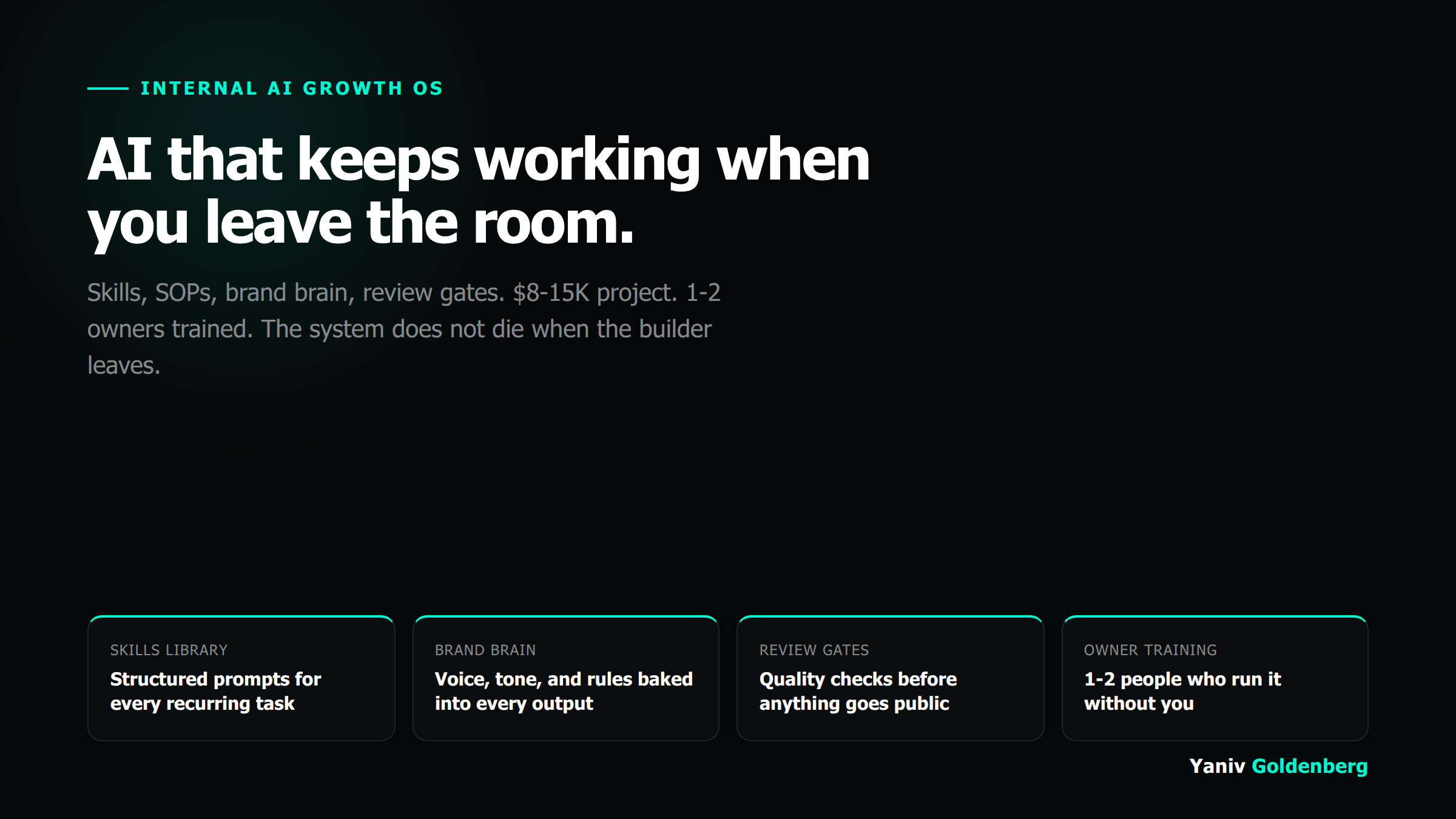
An internal AI growth OS is what separates teams that use AI from teams that run on AI. Using AI means someone prompts a chatbot and gets output. Running on AI means your team has structured prompts for every recurring task, a brand brain that every output passes through before it reaches the channel, review gates that catch low-quality output before it goes public, and 1-2 owners trained to maintain the system without outside help.
The failure mode for most marketing teams with AI access: one person builds something clever in ChatGPT, does not document it, and when they leave, the system disappears with them. This project prevents that.
$8,000-$15,000 project. Documentation and training included.
Teams this is built for and teams that need something else
Right fit for the internal AI growth OS:
Marketing team of 3-15 that already uses Claude, ChatGPT, or Gemini inconsistently
Company where AI output quality varies because each person prompts differently
Team where AI knowledge lives in one person's head and is not documented
Company that has seen AI-generated content reach the channel without QA and regretted it
B2B SaaS or tech company where brand voice consistency is a real concern
Not the right fit:
Team of 1: if you are the only person, there is no system to hand off
No AI tools in the budget: the OS systematizes what you already have, not software you don't
Pre-PMF without a marketing function: build the product first
Looking for prompt engineering workshops without documentation or ownership: different product
Want someone to manage AI output for you long-term: that is AI Foundation or Premium
Six layers from audit to owner handoff
AI usage audit
Map every current AI-assisted task across the team: what gets prompted, by whom, how often, and with what result. Rank by time saved and quality risk. The top 8-12 tasks become the first OS layer.
Prompt library for recurring tasks
Structured prompts for the tasks that happen every week: content briefs, social copy, email drafts, competitor research, meeting summaries, campaign analysis. Each prompt tested with the team's real inputs before it goes into the library.
Brand brain document
A structured document your prompts reference: voice principles, tone guardrails, banned phrases, approved proof claims, format rules, and examples of on-brand vs off-brand output. Every LLM output routes through it.
SOPs with AI steps embedded
Your existing content, campaign, and reporting SOPs rewritten with LLM steps explicitly sequenced in. Not a separate AI process alongside the SOP. The SOP and the AI step are the same document.
Review gates and quality checklist
A checklist protocol for every AI-assisted deliverable before it reaches the channel: brand voice, factual accuracy, slop detection, approval sign-off. Human reviewer time drops from 30 minutes to 8 minutes per piece when the output already passed the gate.
Owner training and handoff
1-2 internal team members trained on the full OS: how to update the prompt library, how to add a new SOP, how to update the brand brain after a rebrand. Two weeks of live-task practice before handoff. Full documentation in a shared folder your team controls.
Skills, brand brain, review gates, owner training: what the OS installs
Week 1 to week 6: from audit to a team that runs without you
AI usage audit and task ranking
Interview the team, map every AI-assisted workflow, and rank tasks by time impact and quality risk. Identify the first 8-12 tasks to systematize. Agree on the owner profile and training schedule.
Build prompt library, brand brain, review gates
Structured prompts written and tested with the team's real inputs. Brand brain document drafted from existing brand assets and refined with the team. Review gate checklist drafted and walked through live.
SOP embedding, owner training, handoff
Existing SOPs rewritten with AI steps embedded. 1-2 owners trained across live tasks. Handoff complete when the owners can run a new task through the system without help.
Systems that ran after the engagement ended
Internal AI growth OS vs every other option on the table
| Option | What you get | What breaks |
|---|---|---|
| Let the team use ChatGPT freely | Ad hoc output, fast | Inconsistent voice, no documentation, knowledge dies when person leaves |
| Prompt engineering workshop | Better prompts for 2 weeks | No system, no brand brain, no review gates, reverts in a month |
| Hire a marketing ops person | One person who knows | If they leave, the knowledge goes with them |
| Buy an AI content platform | SaaS with templates | Still no brand brain or SOPs, and you pay monthly for something generic |
| Internal AI growth OS | Documented system, 2 trained owners, review gates, brand brain | None: designed to survive team turnover |
Internal AI growth OS FAQ
We already use ChatGPT for content. How is this different?
ChatGPT seats give your team a chat window. The internal AI growth OS gives them a system. The difference is that the OS has structured prompts for each recurring task, a brand brain that every output routes through, review gates that catch low-quality output before it reaches your brand, and an owner who knows how to maintain it. Most teams with ChatGPT seats are doing ad hoc prompting. The OS is a repeatable workflow.
What happens if the internal owner we train leaves?
That is the exact problem this solves. The OS is documented: every prompt, every SOP, every review gate is written down. If the owner leaves, the next person opens the documentation and runs the system within a week. Without documentation, the system lives in the person's head. With it, it lives in a shared folder.
How long does the project take?
Four to six weeks for a typical team. Two weeks auditing current AI usage and identifying high-value recurring tasks. Two weeks building the prompt library, brand brain, and review gates. One to two weeks training 1-2 internal owners in parallel with live tasks.
Which AI tools does this work with?
The OS is tool-agnostic by design. The structured prompts work in Claude, ChatGPT, Gemini, or any LLM your team already pays for. The brand brain is a document structure, not a platform. The review gates are a checklist protocol, not software. You are not locked into any specific tool.
Does this replace our agency?
It does not replace execution capacity. It replaces the ad hoc prompting that produces inconsistent output across your team. If you use an agency for creative production, the OS gives the agency a brand brief and review process it did not have before. If you are considering replacing the agency, see the agency replacement page instead.
What is the difference between this and AI Foundation?
AI Foundation builds the technical automation layer: n8n pipelines, attribution, content systems, dashboards. The internal AI growth OS builds the team operating layer: how your team uses AI, what prompts they use, how they quality-check output, who owns what. Foundation is infrastructure. The OS is process. Some teams need both; many need the OS first.
Where the internal AI growth OS fits in the AI Growth Systems catalog
Tell me which AI tasks your team does today and which person holds the knowledge
30 minutes to map your current AI usage, identify the highest-risk knowledge gaps, and scope what a realistic OS build looks like for your team. If the fit is there, I'll send a scoped proposal the same week.