Signups to Paying Users. Built, Not Theorized.
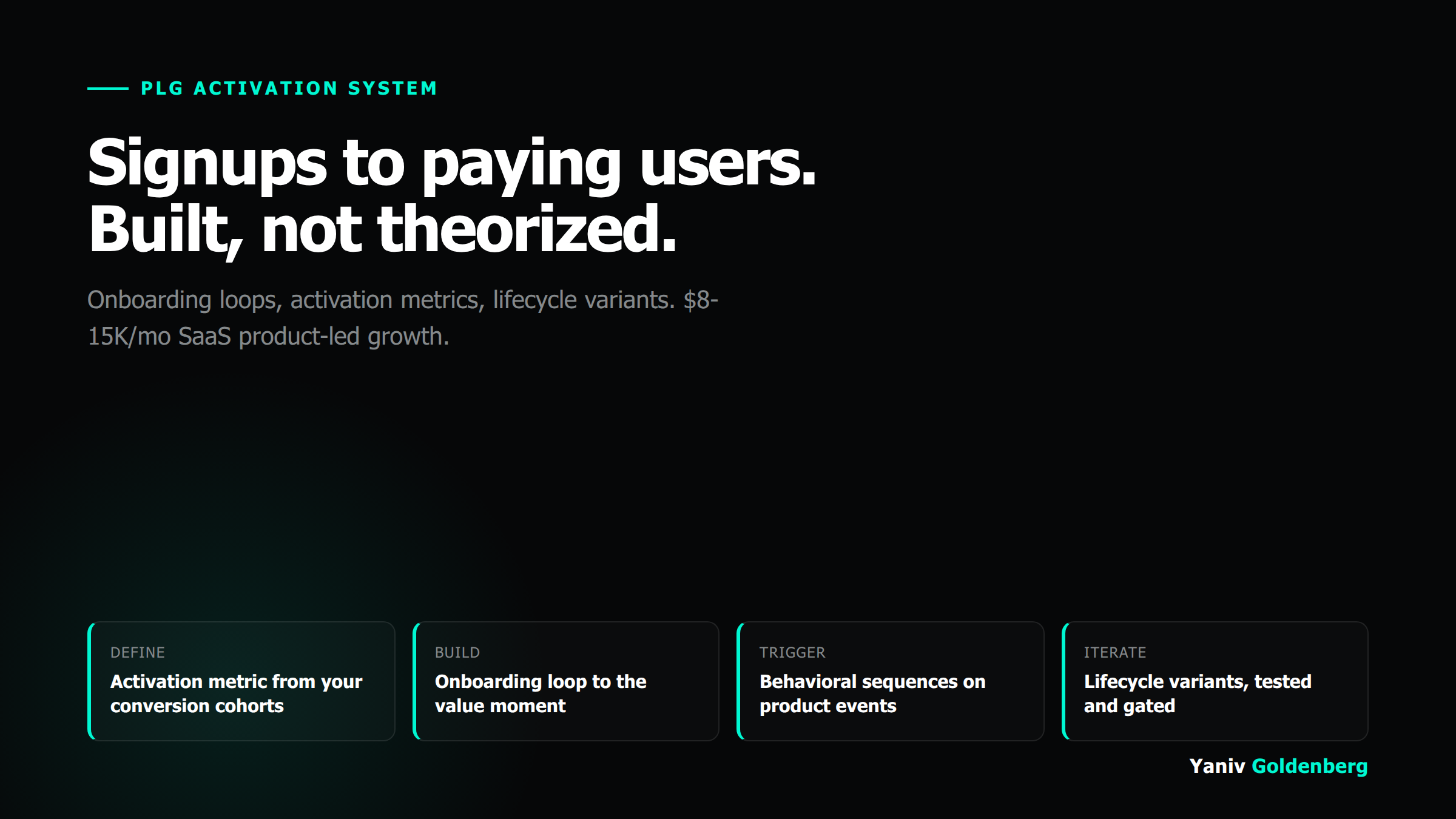
Product-led growth means the product does the selling. But that only works if users reach the value moment before they leave. The PLG activation system defines your activation metric from cohort data, builds the onboarding loop that gets users there, and installs behavioral trigger sequences that re-engage users who drop. $8-15K/mo. Built for your product, not a template.
AI Growth Systems: the operating layer between your ads account and your bank account. I don't rent you ChatGPT. I install a growth machine.
What broken PLG looks like and what replaces it
| The broken activation pattern | What the system replaces it with |
|---|---|
| 'Active user' as the success metric | Specific activation action defined from cohort data |
| Generic welcome email sequence | Behavioral triggers on product events |
| Same onboarding flow for every segment | Lifecycle variants by ICP, use case, and activation stage |
| Drop-off discovered in monthly review | Re-engagement triggered within 48 hours of drop |
| Conversion blamed on pricing | Activation gap identified before the paywall conversation |
Activation metric, onboarding loop, behavioral triggers: built as a system
A PLG activation system is product-led growth built as infrastructure, not as a playbook. It starts with a data analysis that defines your activation metric: the specific action that predicts whether a free user will convert to paid. It builds an onboarding loop that moves new signups toward that action as fast as possible. And it installs behavioral trigger sequences that re-engage users who drop before they reach that activation moment.
For SaaS teams with a free tier, the PLG activation system is where AI Growth Systems meets the product: the conversion work starts at signup, not at the paywall.
$8-15K/mo. Scope depends on product complexity.
Who the PLG activation system is built for
Right fit for the PLG activation system:
SaaS product with a free tier or freemium model and a defined paywall
Signup-to-paid conversion rate below 5% with no clear explanation why
Onboarding sequence that has not been updated in more than 6 months
Team using email opens as the primary activation signal
Product with at least 500 monthly signups (enough cohort data to analyze)
Not the right fit:
Pre-PMF: activation optimization scales a product people want, not one still finding fit
No free tier or trial: this is a PLG engagement, not a sales-led outbound build
Below 200 monthly signups: not enough cohort data to define a reliable activation metric
Attribution broken with no plan to fix it: activation analysis requires clean conversion events
Looking for a playbook: the system is built for your specific product and cohort, not a template
Six deliverables from activation metric to running system
Activation metric definition
Cohort analysis of your signup-to-paid conversion data. Which actions in days 1-7 are predictive of 30-day conversion? That action becomes the activation metric, locked with the product and marketing teams before any onboarding sequences are touched. Every lifecycle decision from this point references this metric.
Onboarding loop redesign
Map the current path from signup to activation moment: which steps move users toward the metric, which create friction, which have no relationship to activation at all. Redesign the critical path to remove friction steps. The loop is built with the product team and tested before full rollout.
Behavioral trigger sequences
Automated sequences that fire on product events, not on time. User completed step 2 but skipped step 3: trigger a specific message about step 3. User activated but did not invite a teammate: trigger a collaboration prompt. Built in your existing lifecycle tool, connected to your product database.
Lifecycle variants by segment
Onboarding is not one size. ICP segment one (solo founder) has a different activation path than segment two (ops team). The system defines 2-3 primary segments, builds variant sequences for each, and runs them in parallel. Variants are gated through a human review before they reach users.
Re-engagement protocol
Users who drop before the activation moment get a structured re-engagement sequence within 48 hours of the drop event. Not a generic 'we miss you' email. A specific message about the step they did not complete, with a low-friction path back. Re-engagement is triggered by product behavior, not by a 7-day timer.
Activation dashboard and monthly review
Live view of activation rate, time-to-activation, segment breakdown, and variant performance. Monthly review with the team: what moved, what did not, which variants are ready to scale, which segments need a different approach. The dashboard is owned by the marketing team, not by the agency.
Signup to activation: the full PLG flow
Month 1 to month 3: from cohort analysis to co-piloted system
Cohort data, metric definition, onboarding audit
Pull your conversion cohorts and define the activation metric from data. Audit the current onboarding sequence against the metric. Map product events available in your current tool stack. Deliver the activation definition and the 90-day build plan by week four.
Behavioral triggers, segment variants, re-engagement live
Build and launch the primary behavioral trigger sequences in your lifecycle tool. First two segment variants tested and gated. Re-engagement protocol live for users who drop before activation. First activation rate data compared to pre-engagement baseline.
Variant testing, performance review, system handoff
Additional variants based on month two data. Activation dashboard live and reviewed monthly with the team. By month three, the marketing team co-pilots the system. By month five, they run it independently.
Operating experience with product-led growth at scale
PLG activation system vs every other option on the table
| Option | What you get | The problem |
|---|---|---|
| Generic welcome email sequence | High open rates, low activation | No connection to product behavior |
| Lifecycle marketing retainer | Email metrics | Starts at the inbox, not at the product |
| Growth agency with PLG experience | Their framework on your product | You own none of the system when they leave |
| In-house junior growth hire | Energy without activation data expertise | $60-80K/yr to learn on your product |
| PLG activation system (this) | Activation metric from your data, system owned internally | None: built for your product, documentation included |
PLG activation system FAQ
What is a PLG activation system?
PLG stands for product-led growth: the product does the selling through usage and activation, not through an outbound sales team. A PLG activation system is the infrastructure that makes that work: an onboarding loop that gets users to first value fast, activation metrics that measure whether they got there, and lifecycle variants that re-engage users who dropped before activating. It is a built system, not a playbook.
What is the activation metric and how do we define it?
The activation metric is the specific action a user takes that predicts whether they will convert to paid. Not login. Not 'active user'. The metric is defined by analyzing your conversion cohorts: which behaviors in the first 7 days are predictive of 30-day conversion. In week two of the engagement, we run that analysis on your data and lock the activation definition before building any onboarding sequences.
How is this different from a standard lifecycle marketing retainer?
Lifecycle retainers manage email sequences. The PLG activation system starts earlier: it maps the product experience from signup to activation moment, identifies where users drop, and builds automated sequences that respond to product behavior, not just email open patterns. The system talks to your product database, not just your email platform.
We have Intercom or HubSpot. Can you work with that?
Yes. The activation system is built on your existing tools: Intercom, HubSpot, Customer.io, Braze, or similar. The work is in defining the behavioral triggers, the variant logic, and the activation metric, not in replacing the platform. Week one includes an audit of your current tool setup and what it can support before any build work starts.
Do we need a product team involved?
Yes. The onboarding loop design involves product decisions, not just marketing decisions. The engagement requires 2-3 calls with the product team in the first month to map the product experience and lock the activation definition. After month one, the marketing team owns the lifecycle sequences and the product team reviews monthly, not weekly.
What if our free-to-paid conversion rate is very low, like below 2%?
Below 2% conversion usually means one of three things: the activation moment is not clearly defined in the product, the onboarding loop drops users before they reach it, or the free tier attracts users who will never pay. The diagnostic in month one identifies which one it is. Not all activation problems are fixed with better sequences. Some require a product change. If that is the case, I will say so before the engagement goes further.
Where PLG activation fits in the AI Growth Systems catalog
"Activation is where growth is won or lost. If new users do not reach value fast, no amount of acquisition will save the funnel."
Activation is where customer success and go-to-market strategy meet the product: free-to-paid conversion depends on users reaching value before the funnel leaks them, not on a bigger acquisition budget.
Show me your activation rate and your current onboarding sequence
30 minutes to review your signup-to-paid cohort data and map where users drop before the value moment. If the activation metric is unclear, that is where we start. Scoped engagement proposal the same week if the fit is there.