
Fractional Chief Growth Officer
A fractional chief growth officer owns your entire growth engine: marketing, sales, product-led motion, and retention, under one revenue blueprint. Not a campaign manager. Not an agency. A part-time C-suite operator accountable for the number.
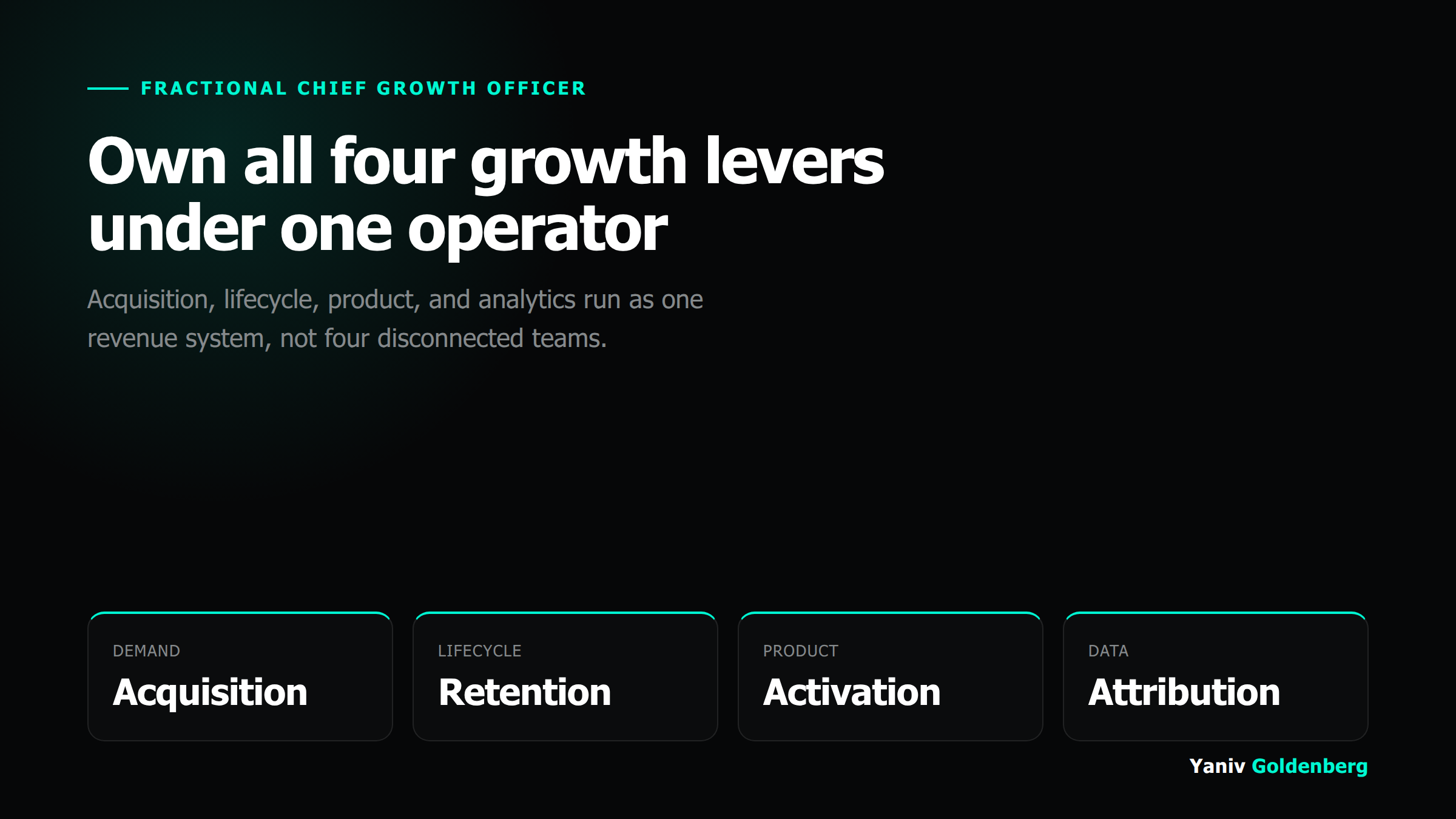
A fractional chief growth officer is not a part-time CMO with a narrower title. The role exists because most scaling companies split growth across four teams that never share a number: paid acquisition, lifecycle and retention, product activation, and analytics. Each optimizes its own metric, and the revenue line falls through the gaps between them. A fractional chief growth officer owns all four levers under one operator and one revenue view, so a paid click is traced to activation, activation to retention, and retention to expansion revenue. The mandate is senior, outcome-based, and time-boxed: install the system, prove the unit economics, and hand a running machine to the team. For the underlying discipline, see the Harvard Business Review research on revenue systems.
A fractional CGO owns revenue, not a channel
Most fractional executives own a slice. A fractional CMO owns marketing. A VP of Sales owns the pipeline. A fractional chief growth officer owns the connective tissue between all of them: the single revenue blueprint that makes product, marketing, sales, and customer success pull in the same direction.
Growth rarely stalls inside one function. It stalls in the seams: leads marketing generates and sales never works, a product-led motion with no commercial owner, expansion revenue nobody is accountable for. A channel specialist cannot fix a seam problem. Someone has to own the whole engine. I ran exactly that scope at Elementor, taking the growth function through a $200K-to-$20M ARR arc, and the attribution model, channel architecture, and team I built are still running.
One operator, four levers, one number
GTM and cross-functional alignment
Break the silos. Product, marketing, and sales operate from one growth blueprint instead of three competing roadmaps. This is the lever that unlocks the other three.
Revenue operations
Diagnose funnel friction, cut customer acquisition cost, raise lifetime value. Real attribution, not last-click vanity. Where most of my early wins come from, because it is where most companies are blind.
Sales optimization
Build a predictable pipeline, mentor the account executives, raise close rates. Marketing that generates leads sales cannot convert is just expensive noise, so the CGO owns the handoff.
Retention and expansion
Keep accounts sticky and grow net revenue retention. In a subscription business, expansion is cheaper than acquisition and it compounds. A CGO is accountable for it; a CMO usually is not.
Where the two roles diverge
| Dimension | Fractional CMO | Fractional CGO |
|---|---|---|
| Primary mandate | Marketing performance | Revenue end to end |
| Owns sales | No | Yes |
| Owns retention / NRR | Rarely | Yes |
| Accountable metric | Pipeline, MQLs, brand | Net new revenue, NRR |
| Best when | Marketing is the gap | The gap spans functions |
What a fractional CGO engagement looks like
Diagnose before touching anything
Map the full funnel, instrument real attribution, find where revenue actually leaks. Most companies have a strong opinion about their bottleneck and most of those opinions are wrong.
Write one growth blueprint
One plan product, marketing, and sales all operate from: a single definition of a qualified lead, one source of truth for pipeline, one owner for expansion revenue. An operating system, never a slide deck.
Own one number
Stay accountable to one agreed metric, usually net new revenue or net revenue retention. If a tactic does not move it, it does not happen. One to three days a week, three to twelve months.
Why companies hire a fractional CGO now
Growth-stage companies need senior, cross-functional revenue leadership long before they can justify a permanent $250K-plus chief growth officer. Hiring a full-time CGO too early burns runway and locks you into one playbook before you know the shape of the problem.
The same person who diagnoses the leak owns the fix and reports the result.
A fractional engagement inverts that. You get a C-suite operator who has run the full revenue engine before, at the bandwidth the problem needs, with a defined scope and a clean exit. It fits two moments especially well: a growth plateau where the bottleneck is genuinely unclear, and fundraise or exit prep, where investors buy a credible, repeatable growth model rather than last quarter numbers.
The model works because accountability is concentrated. One operator owns the number across marketing, sales, and retention, so there is no finger-pointing between functions when growth stalls. The same person who diagnoses the leak owns the fix and reports the result.
Everything you need to evaluate a fractional CGO
- CGO vs CMOThe scope difference that decides which role you actually need.→
- What a CGO doesThe role broken into a real working week and four core duties.→
- Cost and ratesDay-rate math versus a $250K-plus full-time hire.→
- When to hire oneThe four trigger signals that mean it is time.→
- CGO for SaaSNRR, PLG, and CAC payback specifics for subscription businesses.→
- CGO vs VP GrowthC-suite revenue owner versus functional growth lead.→
- How to hire oneThe six-step process, and operator versus network.→
- CGO vs agencyEmbedded executive accountability versus an outsourced agency.→
- ROI and paybackHow to measure the return: CAC, LTV, NRR, and payback period.→
Tell me where growth is stuck and I will tell you what it takes
What has stalled, what the funnel looks like now, what the board expects next. I will tell you whether a fractional CGO is the right call, what bandwidth the engine needs, and what the first 30 days look like.
Fractional chief growth officer FAQ
What is a fractional chief growth officer?
A fractional chief growth officer is a part-time C-suite executive who owns your entire revenue engine, aligning marketing, sales, product, and customer success under one growth strategy. Engagements typically run 1-3 days a week over 3-12 months at a fraction of a full-time hire's cost.
How is a fractional CGO different from a fractional CMO?
A CMO owns marketing. A CGO owns revenue end to end, including sales, retention, and the product-led motion. If your growth problem lives in the seams between functions rather than inside marketing, you need a CGO, not a CMO.
How much does a fractional CGO cost?
Most engagements run $3,000 to $15,000-plus per month depending on days per week and company stage, versus a $250K-plus total cost for a full-time chief growth officer.
When should a company hire a fractional CGO?
When growth has stalled and you cannot find the bottleneck, when sales and marketing are siloed, when you are preparing for a raise and need a credible growth model, or when you need executive direction without a permanent six-figure salary.