
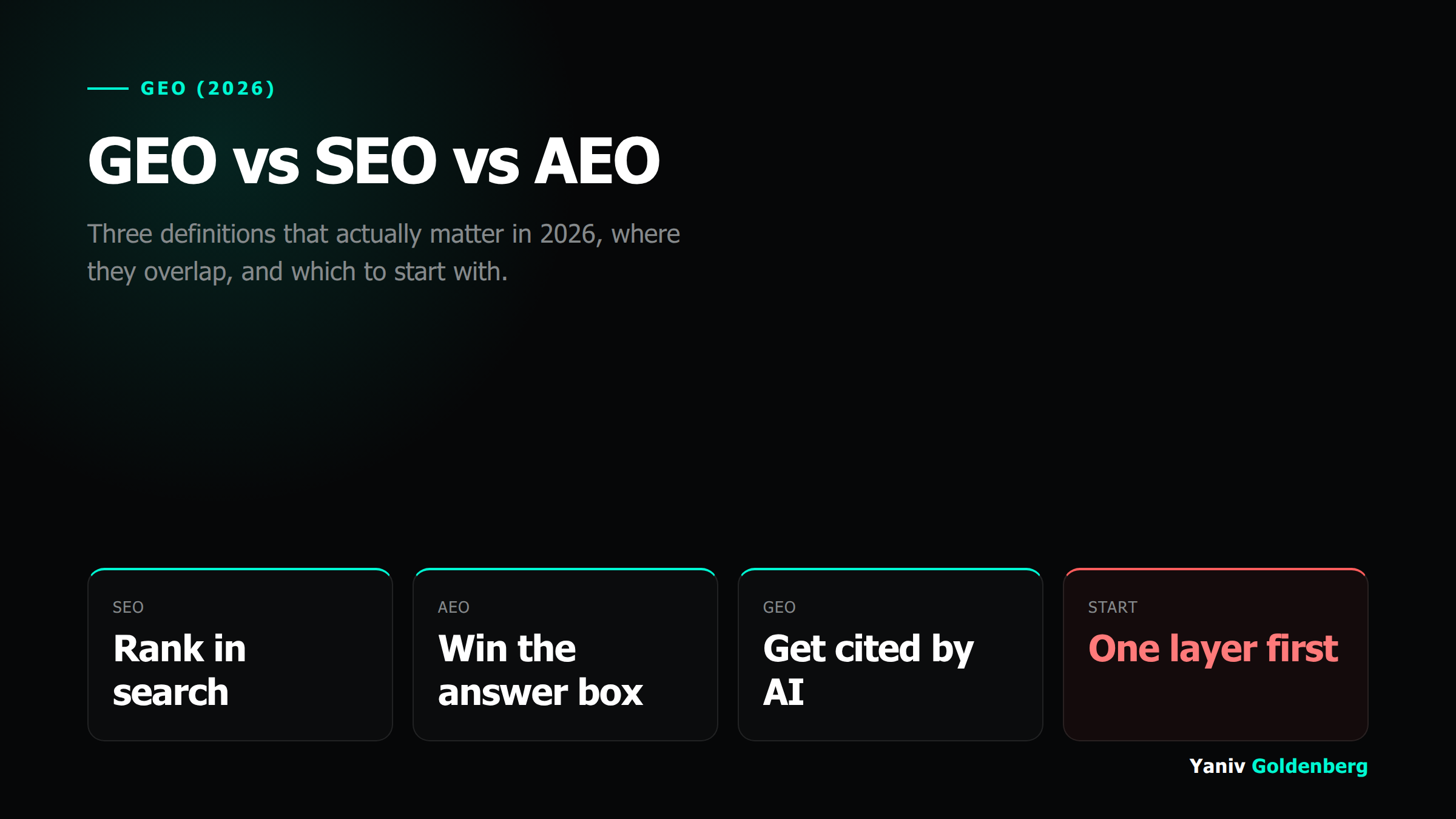
GEO vs SEO vs AEO gets treated like a turf war, but it is really three layers. Here is the GEO vs SEO distinction that actually matters in 2026, in plain terms.
SEO optimizes for Google's blue-link results. AEO (Answer Engine Optimization) optimizes for direct-answer surfaces like Google AI Overviews and featured snippets. GEO (Generative Engine Optimization) optimizes for being cited inside generative engines like ChatGPT, Claude, Perplexity, and Gemini. The three overlap technically but diverge in tactics.
SEO optimizes for Google's blue-link results. AEO (Answer Engine Optimization) optimizes for direct-answer surfaces like Google AI Overviews and featured snippets. GEO (Generative Engine Optimization) optimizes for being cited inside generative engines like ChatGPT, Claude, Perplexity, and Gemini. The three overlap technically but diverge in tactics.
The three definitions in one sentence each
- SEO (Search Engine Optimization): structuring content and signals so search engines rank your page in their results.
- AEO (Answer Engine Optimization): structuring content so search engines extract and display your answer directly in zero-click surfaces.
- GEO (Generative Engine Optimization): structuring content so generative engines retrieve, summarize, and cite your page when answering user queries.
Where they overlap
- All three reward crawlability, valid schema, and clean technical SEO
- All three reward content quality and topical authority
- All three reward strong author/entity identity (Person and Organization schema)
- All three reward freshness and recency signals
Where they diverge
SEO-specific tactics
- Backlink acquisition for ranking weight
- Click-through-rate optimization on title and meta description
- Internal linking for crawl prioritization
- Core Web Vitals tuning (LCP, INP, CLS)
AEO-specific tactics
- Answer-first paragraph structure (40-60 words at the top of every section)
- FAQ schema on every page that has Q-and-A content
- Tabular data and lists that lift cleanly into snippets
- Speakable schema for voice-assistant surfaces
GEO-specific tactics
- TL;DR blocks at the top of every page
- Entity disambiguation via Person and Organization schema with full sameAs
- llms.txt and llms-full.txt for curated LLM consumption
- Original data, methodology pages, and citation magnets
- Crawler allowances for GPTBot, ClaudeBot, PerplexityBot, OAI-SearchBot
Which one to start with
If you have decent SEO already, start with GEO. The marginal effort to add TL;DR blocks, entity schema, and crawler allowances is small, and the upside is access to a fast-growing set of buyers who are increasingly using generative engines to shortlist vendors. AEO follows naturally from GEO work because answer-first structure is the shared foundation.
Frequently asked questions
Is GEO replacing SEO?
No. Google's blue-link search still drives the majority of organic web traffic in 2026. GEO is an additive optimization surface, not a replacement. Most companies should do both.
Are GEO results measurable?
Yes, but probabilistically. Citation presence in ChatGPT, Claude, Perplexity, and Gemini can be measured by querying the engines directly. Tools like the open-source seo-geo-skill benchmark provide a 100-point AI Visibility Score across all major engines.
Who coined the term GEO?
The term gained academic prominence in a 2023 paper from Princeton, Georgia Tech, and Allen Institute ("GEO: Generative Engine Optimization"). The term has since been adopted by industry as the standard label for this optimization surface.
GEO vs SEO in practice: where to spend first
Once you accept that GEO vs SEO is a question of layers, spending gets clearer. The base layer is technical and content health: a crawlable, fast, well-structured site with real authority. That base is what earns rankings, feeds answer boxes, and makes you eligible for AI citations all at once, so it is never wasted spend. On top of it, GEO work is mostly about being the quotable primary source: original data, answer-first structure, and entity clarity so an engine can attribute a claim to you by name.
In practice, a business that is invisible in traditional search rarely wins in AI answers either, because the same weaknesses, thin content, poor structure, no authority, sink both. So the sequence for most companies is: fix the SEO base, then layer GEO deliberately on your highest-intent pages, the ones a buyer reaches right before a decision. That is where a citation is worth the most, and where the same well-built page can rank, win the answer, and get cited at the same time. GEO vs SEO stops being a budget fight the moment you treat one page, built well, as the thing that wins all three.
A practical GEO vs SEO checklist
Turning the GEO vs SEO distinction into action is simpler than the debate suggests. Start with the SEO base: confirm the site is crawlable, fast, and technically clean, that titles and structure are sane, and that you have real authority on the topics you sell. This base is non-negotiable, because a page that cannot rank or be crawled will not be cited either. With that in place, the GEO layer is mostly about being the quotable primary source on your highest-intent pages: lead with the direct answer, back it with one original number and a source, and make your entity unambiguous so an engine can attribute the claim to you by name.
Then measure both worlds. Track your rankings and organic traffic as always, but also run your buyer's real questions through ChatGPT, Perplexity and Gemini and record where you appear. When a page ranks in Google but never gets cited by an AI, the fix is usually structure and specificity, not more backlinks. When a page gets cited but does not rank, it often needs the classic SEO signals to catch up. Treating GEO vs SEO as one scoreboard with two columns, rather than two rival budgets, is what lets a single well-built page rank, win the answer box, and get cited in an AI response at the same time. That is the whole point: one page, built right, wins everywhere your buyer looks.
"GEO, SEO and AEO are not rivals; they are layers. The brand that treats them as one budget, not three turf wars, is the one that shows up when a buyer worth $50,000 asks an AI which vendor to trust."
In one sentence each: SEO is getting your pages to rank in traditional search results; AEO, answer engine optimization, is winning the direct answer box or featured snippet; and GEO, generative engine optimization, is getting cited inside AI-generated answers from ChatGPT, Perplexity and Gemini. They overlap heavily, because the fundamentals that earn a ranking, clean structure, real authority, crawlability, are the same ones that earn an answer or a citation. Where they diverge is the target: a ranking is a blue link, an answer is a lifted snippet, a citation is a named mention inside a synthesized response.
So which do you start with? Start with the layer closest to how your buyers already search. If they still Google and click, SEO is the base and everything else compounds on it. If they increasingly ask ChatGPT or Perplexity before they ever reach Google, GEO stops being optional. For most businesses in 2026 the honest answer is that GEO vs SEO is not either-or: you keep the SEO base healthy and add the GEO layer on top, because the same page, structured well, can rank, win the answer, and get cited at once.
Further reading: Search engine optimization and Question answering. Related: GEO (AI search), SEO consulting, AI visibility audit.