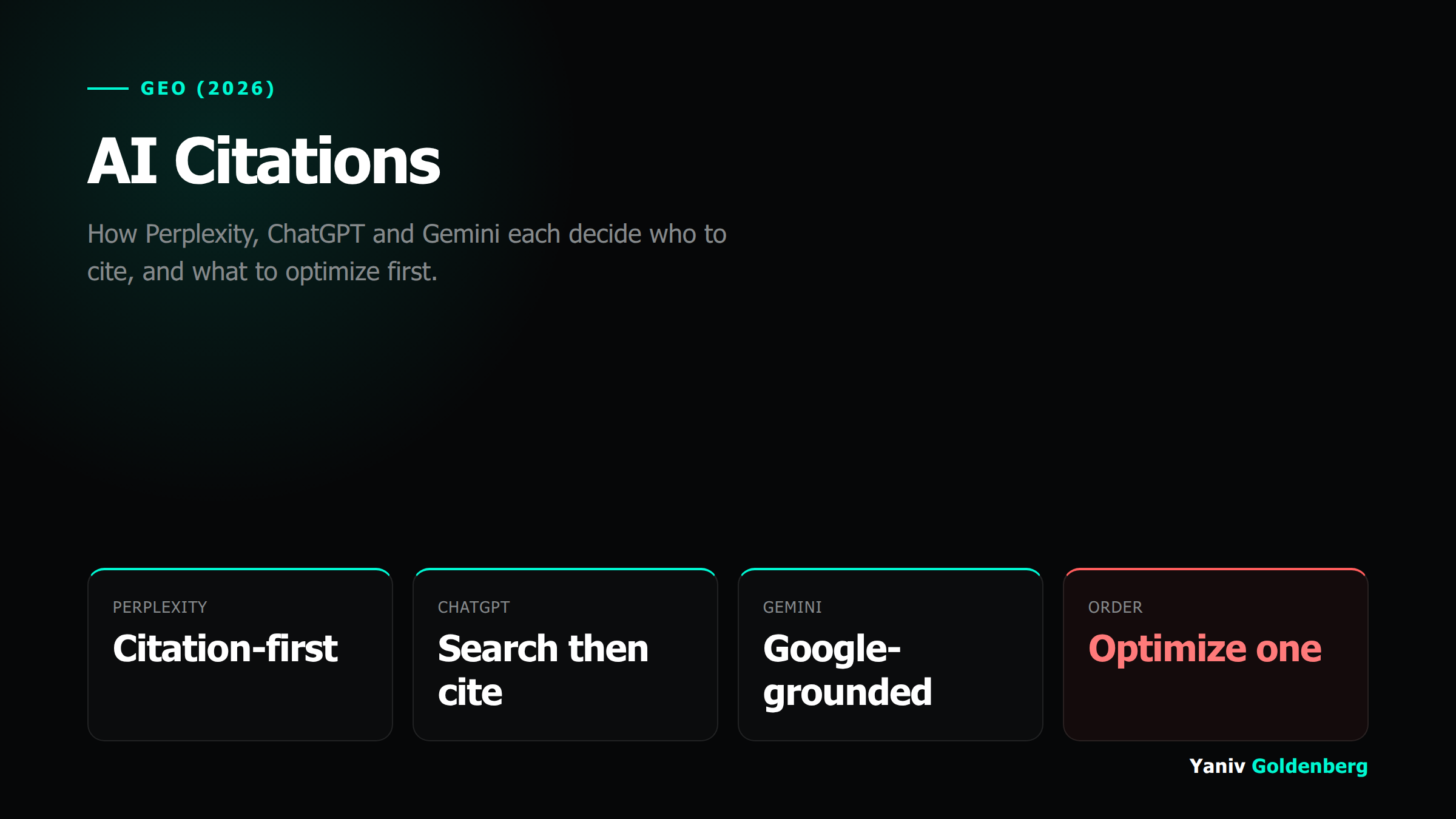
AI citations are not one game but three. Winning AI citations in Perplexity, ChatGPT and Gemini means understanding how each engine chooses its sources.
The three major generative search engines pick sources differently. Perplexity is citation-first by design and shows its sources inline. ChatGPT search surfaces sites through OpenAI's own OAI-SearchBot crawler, and its Reddit citations fell 86% in mid-August 2026. Gemini grounds answers in Google's Search index. Optimization tactics differ by engine.
The three major generative search engines pick sources differently. Perplexity is citation-first by design and shows its sources inline. ChatGPT search surfaces sites through OpenAI's own OAI-SearchBot crawler, and its Reddit citations fell 86% in mid-August 2026. Gemini grounds answers in Google's Search index. Optimization tactics differ by engine.
How each engine handles citations
- Perplexity: citation-first product. Answers show numbered source links inline. PerplexityBot is the crawler that surfaces and links sites in its search results (Perplexity).
- ChatGPT: search runs on OpenAI's own crawler. Sites opted out of OAI-SearchBot will not be shown in ChatGPT search answers (OpenAI). The source mix moves fast: Reddit held a steady 3.8% share of ChatGPT Search citations from July 18 to August 7, 2026, then averaged 0.5% on August 14-17, an 86% drop. PromptWatch flags the size of that drop as provisional (PromptWatch, 2026).
- Gemini: grounds answers in content from the Google Search index at prompt time. Google-Extended is the control for that grounding use in Gemini Apps (Google Search Central).
- Claude: searches the web and returns cited answers on all plans (Anthropic, 2025).
- Google AI Overviews: part of Google Search. Blocking Google-Extended does not remove you, because it does not affect a site's inclusion in Google Search (Google Search Central).
What each engine rewards
Perplexity
Build original data, methodology pages, definitions, and well-structured how-to content, keep it fresh, and make sure PerplexityBot can reach it.
ChatGPT
Build entity-clear content with an answer-first structure and valid Article schema. I no longer list FAQPage: Google retired FAQ rich results on May 7, 2026 (Google Search Central, 2026). Answer adjacent questions on the same page so one page covers several related prompts, and do not block OAI-SearchBot if you want to appear in ChatGPT search.
Gemini
Lean on your Google strength: strong author identity (Person schema with sameAs), publication dates, and original citations. The access control is Google-Extended, which governs Gemini training and grounding, not Google Search (Google Search Central).
Optimization order if you have to pick one
If you have to optimize for one engine first, start with the one your buyers actually use. The optimizations that make a page Perplexity-citable also make it ChatGPT-citable, with marginal additional work for Gemini.
Frequently asked questions
Which engine has the most users?
Google says more than 1 billion people use the Gemini app every month (Google, 2026). Engines publish usage in different units, so compare with care and pick the engine your buyers actually use.
Should I optimize for all five engines simultaneously?
Yes. The technical foundation (schema, crawler access, content extractability, entity disambiguation) is shared across all five. Engine-specific tuning happens on top of that foundation, not instead of it.
Does Perplexity have its own crawler?
Yes. PerplexityBot surfaces and links sites in Perplexity search results, so allow it in robots.txt. One pitfall: robots.txt is a request, not a lock. OpenAI says robots.txt rules may not apply to user-initiated ChatGPT-User fetches (OpenAI), Perplexity says its user-triggered fetcher generally ignores them (Perplexity), and Cloudflare caught Perplexity crawling with an undeclared browser user agent after its declared bot was blocked (Cloudflare, 2025). A crawler also follows only the most specific group that matches its name (Google Search Central), so a bare User-agent: * block catches every bot you did not name, including the ones you meant to let in. Write separate rules per bot family: training (GPTBot), search (OAI-SearchBot, PerplexityBot) and user fetchers (ChatGPT-User, Perplexity-User).
How to win AI citations in each engine
The tactics that earn AI citations are the same fundamentals applied with a different emphasis per engine. For Perplexity, the priority is being in the retrieval set: publish tightly-scoped pages that answer one question well, keep them fresh, and make sure your structured data and headings map cleanly to the queries you want to own. Perplexity cites several sources per answer, so the bar to be one of them is lower than most people assume, which is exactly why it is the fastest place to see early AI citations.
For ChatGPT, the emphasis shifts to authority and clean quotability. ChatGPT cites a smaller set, so it favors the page that owns the claim with a first-hand number, a named framework, or original research, presented answer-first so a self-contained passage can be lifted. For Gemini, lean on your existing SEO and entity strength: consistent Organization and Person schema, strong internal linking, and the same content that earns Google visibility. Across all three, the compounding move is original data: a statistic only you can provide is the single most reliable way to turn a page into a repeat source of AI citations.
Measure it like any channel. Run your buyer's real questions through all three engines monthly, record where you appear and where a competitor wins, and ship one improvement per gap. AI citations are not a mystery once you treat them as a measurable, engine-specific game rather than a single lottery.
How to track your AI citations over time
The reason most brands never win AI citations is that they never measure them. Build a simple tracking sheet: list the ten to twenty questions your buyers actually ask, run each through Perplexity, ChatGPT and Gemini once a month, and record for every question whether you were cited, who else was, in what position, and how that share of voice changed from the previous month. Within two cycles you will see a pattern: the questions you own, the questions a competitor owns, and the questions nobody owns yet. That last group is the fastest opportunity, because an unclaimed question is a citation waiting for the first genuinely useful answer.
Then close the gaps one at a time. For each question a competitor wins, open the page the engine cited and diagnose what it did that you did not: a cleaner answer-first passage, a real statistic with a source, better structure, or simply being fresh and crawlable while you were stale. Ship that one improvement, wait a cycle, and confirm your AI citations for that question moved. This loop, measure, diagnose, ship, re-measure, is the entire discipline. It turns AI citations from something you hope happens into a channel you compound on purpose, the same way you would compound any paid or organic channel that you actually instrument.
"I have seen a single Perplexity citation drive more qualified traffic than a $5,000 ad campaign, because it arrives with the engine's trust attached and repeats for free."
Perplexity is citation-first by design: it retrieves a set of sources for almost every answer and shows them inline, so being in that retrieval set is the whole game. It rewards pages that are clearly structured, recently updated, and directly on-topic for the query. ChatGPT with web search runs a retrieval step through its own crawler and cites a smaller set, favoring authoritative, answer-first pages it can quote cleanly. Gemini leans on Google's index and grounding, so classic SEO signals and strong entity clarity carry more weight there than on the other two.
The practical implication is that AI citations reward the same fundamentals in a different order. If you can only optimize for one engine, start with the one your buyers actually use, then widen. For most B2B audiences that is ChatGPT; for research-heavy or comparison queries it is often Perplexity; for anyone deep in the Google ecosystem, Gemini. Ship original data, structure it answer-first under question-shaped headings, keep it crawlable and fresh, and you will earn AI citations across all three rather than gaming any single one.
Further reading: Perplexity AI and Large language model. Related: GEO (AI search), AI visibility audit, More on AI search.